Featured Image

What’s new in Time Harmony 3.17& 3.18: A comprehensive Team Management and performance analytics tool

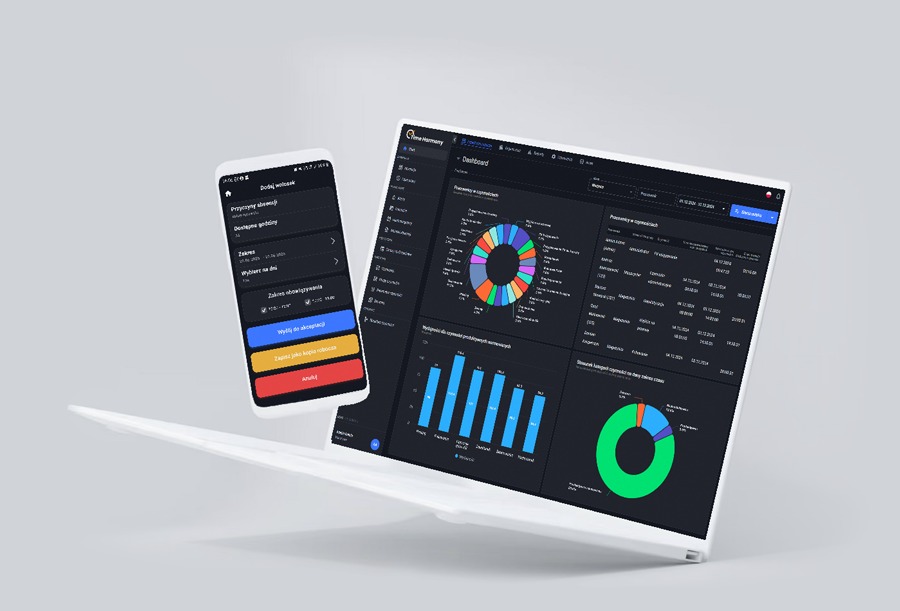
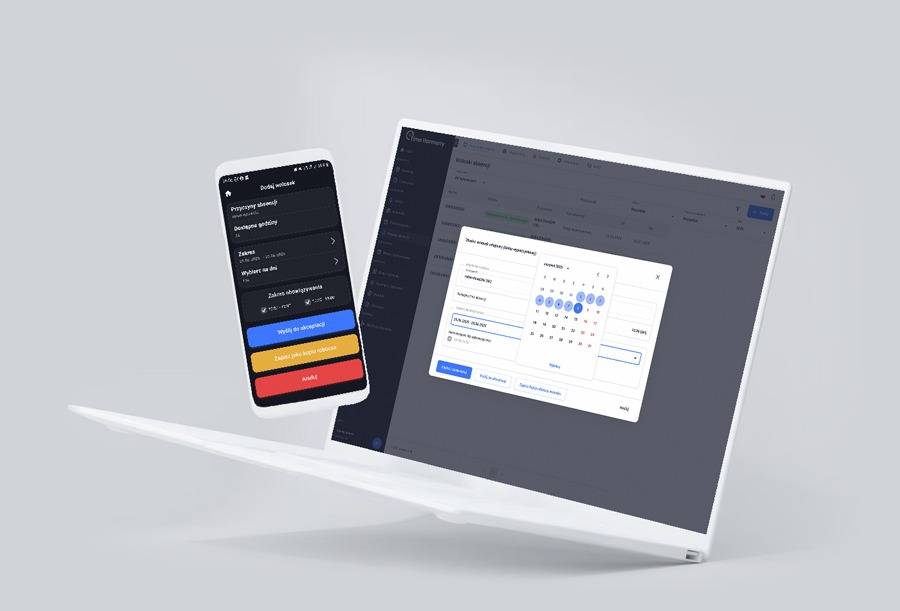
In today’s rapidly changing work environment, the key to success lies in the flexibility of HR tools and the speed of information flow. The latest update to the Time Harmony system and it’s components web application My Time Harmony (MTH) and the My Time Harmony Mobile (MTHM) app introduces solutions that redefine how companies manage access to functions and communicate with distributed teams.

Below is a detailed analysis of the key changes, including a major logistical breakthrough: an advanced performance report that makes our system an even more effective team management and performance analytics tool for business process optimization.


1. Centralized function scope management – personalization without compromise

We have introduced an advanced mechanism for controlling module visibility, allowing administrators to precisely shape the team's work environment within a given instance. Administrators now have full control over which sections of the system are visible to employees in specific applications.

  • MTH (Web App): Ability to toggle visibility for key modules such as T&A (Time and Attendance) event registration, activity logging, and Messaging.
  • MTHM (Mobile App): Offers full granularity with 17 independent toggles, allowing for an extremely precise definition of functions available on smartphones.

This functionality features practical configuration independence. The system allows for separate function definitions for both platforms. For example, the T&A module can be active in the browser while disabled in the mobile app, depending on the company’s strategy.

📌 Objective: To eliminate information noise and provide employees and administrators with the exact tools they need, aligned with the adopted time and activity tracking strategy.


2. "Work time and performance summary" report

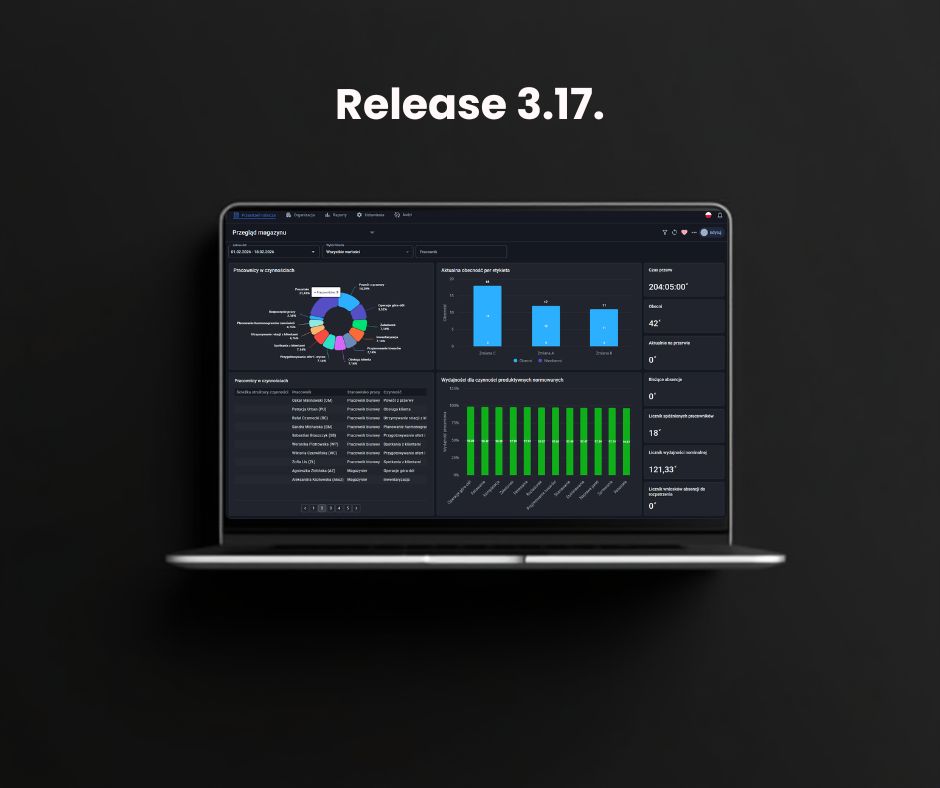
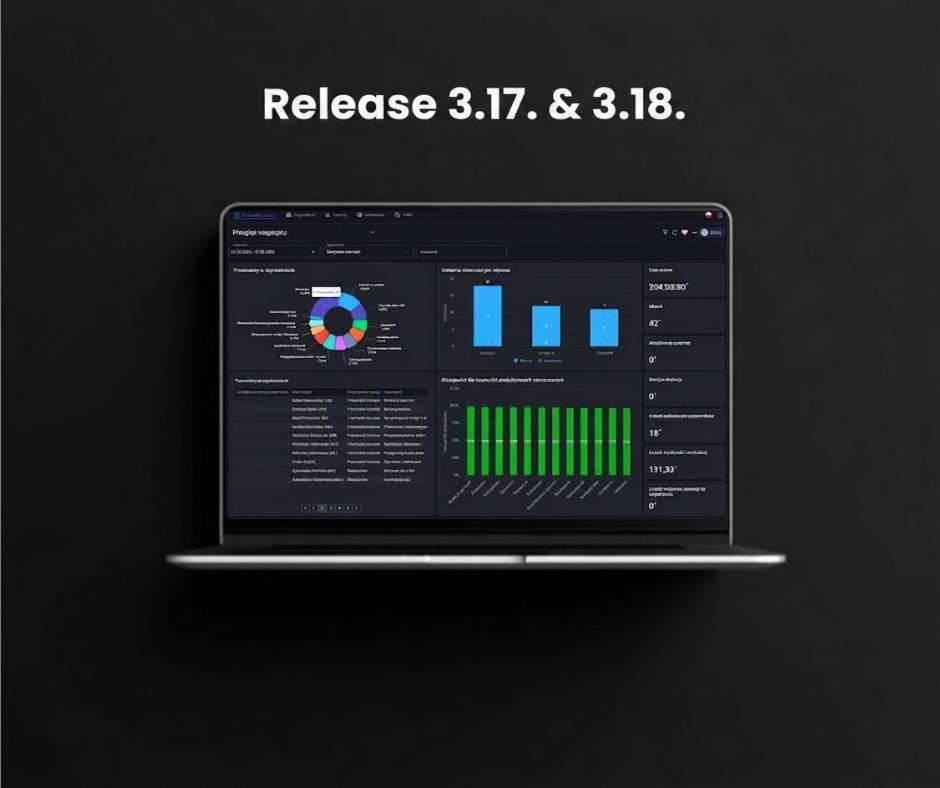
This is a milestone in the evolution of Time Harmony as a team management and performance analytics tool. We have introduced an advanced analytical feature that allows for a comprehensive verification of team efficiency within a single, condensed view.

We have already been piloting this report with some of our clients, and their feedback is unanimous: the tool perfectly highlights the correlation between attendance and actual task completion. Today, we are excited to release this feature to all users.

Benefits for Warehouse Operations

In the logistics and warehouse environment, where every minute impacts the supply chain, this report provides crucial support:

  • Idle Time Analysis (Eliminating "Hidden" Inactivity): The report monitors time at the beginning and end of shifts. In warehouses, this helps detect whether employees actually start logistical processes immediately after clocking in or if operational delays occur.
  • Work Time Structure: Breaking down time into productive (standard) and non-standard categories helps warehouse managers understand how much time is spent on actual tasks (like picking or loading) versus downtime.
  • Punctuality and Continuity: Precise verification of start and end times facilitates supervision over shift fluidity, which is critical for on-time shipping.
  • KPI Achievement: Comparing results against set performance indicators allows for real-time adjustments to staffing and warehouse plans.

Reports can be generated on-demand (export to Excel) or configured for automated delivery, ensuring warehouse managers receive ready-made analyses in their inbox every morning.

📌 Objective: To provide management with instant insight into the relationship between attendance and actual productivity, while fully automating analytical processes in the operational area.

3. Professional messaging module – No more "Gray Zones" in communication

Launching the messaging module directly within the My Time Harmony mobile app (MTHM) is a revolution for companies employing field and production workers.

  • Mass and personalized communication: Send company announcements and documents (e.g., bonus information) directly to the employee's phone.
  • Privacy and security: Communication takes place without the need to share private phone numbers or use insecure external messengers.
  • Guaranteed reach: Integrated with the corporate system, vital information reaches the right people in real time.
📌 Objective: To eliminate digital exclusion for employees without corporate email accounts and to fully professionalize communication channels.


4. Notification system in mobile app – automated supervision

The new notification system is more than just a convenience; it is a proactive team management and performance analytics tool. Alerts displayed on the lock screen inform users of key events in five categories:

  • Early departure – information when the employee left work before the scheduled time.
  • Organization alerts – notifications about expiring or expired contracts, training, medical examinations, documents, resources or employee competencies.
  • Employee absence – a signal in a situation where the employee did not show up for work according to the schedule.
  • Prolonged activity – an alert when a given activity lasts longer than originally assumed.
  • Report notifications – information about the generation of a ready-made report in the Time Harmony system.
📌 Objective: To minimize legal risks through automated supervision of H&S deadlines and to ensure business continuity thanks to instant alerts regarding absences, lateness, or prolonged tasks.


A team management tool that works well in many industries

The changes in version 3.17 are the next step toward not only improving HR processes but, above all, increasing the efficiency of information flow. With these new features, you gain full control over the interface, secure communication, and—thanks to the new report—the most accurate team management and performance analytics tool on the market.

Discover the new possibilities of Moje Time Harmony! Want to learn how to optimally configure the performance report for your company or need support implementing the messaging module?

👉 Contact us or write to our support team: support@timeharmony.pl

👉 Log in to the Admin Panel and test the new configuration options today!


czas pracy

Optimize working time and efficiency of your team
Featured Image

Paid leave for sick pets: A new trend in European labor law?

Pet Leave? Italy sets a new direction in Labor Law

Could caring for a sick pet be considered a justified absence from work? In Italy, a landmark court ruling and new legislative proposals are shifting the perspective on this issue. While this remains a novelty in many regions, offering paid leave for sick pets can be a strategic way for employers to stand out in the war for talent and build a loyal, engaged team.

A groundbreaking ruling in Rome

It all started with an employee of a university in Rome who won a legal battle for the right to paid time off to care for her sick dog. The court ruled that since Italian law penalizes pet abandonment or leaving an animal in distress, the owner has a legal obligation to provide medical assistance. Consequently, the absence from work was deemed justified and fully paid.

Following this ruling, specific proposals to amend Italian labor law have emerged. These include:

  • Up to 3 days of paid leave per year for domestic pet care.
  • Mandatory certification from a veterinarian.
  • Registration requirement, meaning the pet must be officially microchipped.
📌 Italian courts have equated the obligation to care for a sick pet with family responsibilities, paving the way for formal changes in the national Labor Code.


Paid leave for sick pets – A subtle tool in the war for talent

In many legal systems, "pet leave" does not officially exist, and employees typically rely on vacation days or personal leave. However, the labor market is becoming increasingly demanding, and the war for talent forces companies to seek unconventional solutions. Could paid leave for sick pets become a competitive advantage for firms looking to attract top-tier professionals?

The fact is, instead of rigid structures, modern enterprises are opting for greater flexibility. Introducing an extra day off for emergencies involving a pet sends a clear signal to candidates: "We understand your needs and provide a modern workplace." For high-competency employees, this small gesture can carry more weight than standard benefits.

📌Flexibility regarding an employee's private life is a powerful recruitment argument that builds an image of a "humane" and empathetic employer.


Any leave type? It’s simple with Time Harmony

Whether you decide to introduce "pet days" or any other non-standard forms of time off, you need a tool that can handle it without creating administrative chaos.

In the Time Harmony system, we prioritize full configuration freedom:

  • Create any leave type – from standard vacations to specific days off defined by your internal company policy.
  • Set your own limits and rules – you decide if a specific absence is paid, how many days are allowed, and which documents (e.g., a vet’s note) are required.
  • All in one view – managers can instantly see team availability, regardless of the reason for an employee's absence.
📌Time Harmony allows for the instant implementation of custom absence types, giving you full control over costs and workforce planning.


Summary

The shifts in Italian labor law are a fascinating signal from Europe. While statutory changes might not be immediate in every country, flexibility in managing time off is becoming a real asset for entrepreneurs.

Instead of waiting for legal mandates, you can proactively shape your leave policy to attract and retain the best specialists. With Time Harmony, you can do this in just a few clicks.


Want to see how easy it is to configure custom leave types in your company? Explore Time Harmony’s features and manage work time without limits!

cta_2025

Easily manage your company's working time

Featured Image

Time management in multi-branch companies – new in Time Harmony 3.17

Time management in multi-branch companies and international environments requires tools that eliminate language and technological barriers. We are introducing what's new in Time Harmony version 3.17 (released on 16.04.2026), which focuses on precise customization, global standards, and easier integration. The new features allow for advanced module visibility management, full support for English and consistent data exchange with external systems.


Full support for English – standard in international companies

To meet the needs of organizations operating in a distributed model, we have introduced a comprehensive system of translations of proper names and configurations. Until now, the system layer (menus, buttons) was available in English, but proper names (activities, types of absences) remained in the source language. Since version 3.17, the system has become fully bilingual.

Scope of implemented translations:

  • Workspace and desktop: Translations of event names, attributes, and reasons for absences in widgets and alerts.
  • Conclusions and schedules: Names of day types and reasons for absences visible in the selected language (PL/ENG).
  • Reporting and auditing: The results of the reports and the entries in the audit log take into account the translations introduced, which allows reliable data to be shared with foreign management boards.

Why is this solution crucial? In practice, time management in multi-branch companies often encountered a language barrier at the report level. A manager in the UK, analyzing the Polish branch, saw an English menu, but Polish names for activities (e.g. "Line work"). Version 3.17 eliminates this problem – it now sees the "Production Line", which speeds up decision-making processes and eliminates errors in data interpretation.

📌 Business goal: Unification of management standards in multi-branch companies. Thanks to the elimination of language barriers in reports and dictionaries, managers in foreign branches can analyze data on their own without the risk of misinterpretation, which significantly speeds up decision-making processes.

Separation of language configurations for interface and terminals

We've made changes to the language settings to make it easier  to manage working time in multi-branch companies with employees of multiple nationalities:

  1. Interface language (TH/MTHM): Allows selection of the language of the administration panel and the application (PL/ENG).
  2. Stationary terminal language: Applies to the Time Harmony terminals, where a full list of languages (m.in. Ukrainian, Slovak, Spanish and others) is available, which allows employees in production or in the warehouse to record events in their native languages
📌 Business goal: Improve the transparency of the configuration and better fit into the employment structure. The administrator gains clarity about which setting affects management and office staff (PL/ENG) and which allows you to communicate with line workers in their native languages on terminals.

Extended mapping for ERP and SAP systems

Modern time management in multi-branch companies requires smooth data exchange with HR and payroll systems (SAP, Enova, Comarch). Version 3.17 introduces multiple mapping of sections and employers.

The previous model allowed only one identifier to be assigned. The new solution allows one unit in Time Harmony to correspond to different keys in several external systems at the same time.

📌 Business goal: Easier integration and scalability. The solution eliminates data synchronization problems in complex IT ecosystems, allowing you to collaborate with multiple external systems without having to rebuild the database.

Time management in multi-branch companies – systematic development for customers

Version 3.17 is the next step in the process of continuous improvement of Time Harmony. Our priority is to constantly adapt the tool to the dynamically changing needs of the market and the specific requirements of the organizations we work with. The introduced improvements are a direct result of a dialogue with our users, for whom working time management in multi-branch companies must be a process that is as simplified and fully configurable as possible.

In summary, Update 3.17 focuses on two basic pillars:

  • International transparency: Full support for English in dictionaries and reports is a response to the needs of companies that systematically standardize work standards in their foreign branches, eliminating barriers to data interpretation.
  • Openness to IT ecosystems: Extended mapping is a convenience for IT departments, allowing for seamless integration of Time Harmony with ERP systems (SAP, Enova, Comarch) without the need to rebuild the existing database.

In accordance with our philosophy, each subsequent version of the system is a real support in everyday work, resulting from the actual market demand. We invite you to check how the new features will improve processes in your company.

We encourage you to regularly visit our software updates section, where we publish detailed information about further improvements to the Time Harmony system and dedicated applications: terminal and mobile.

Do you have questions about the new version or need help with setup? Contact us – our experts will be happy to help you use the full potential of Time Harmony in your company.


cta_2025

Easily manage your company's working time

Featured Image

New sick leave rules in Poland from April 13, 2026. What has changed?

Compliant with Polish Labour Law

Many employees and business owners are wondering how the new sick leave rules in Poland from April 13, 2026, will work in practice. This date marks a turning point in Polish labor law, introducing regulations that fundamentally change the approach to sick leave (L4) inspections. On one hand, the Social Insurance Institution (ZUS) is gaining more powerful verification tools; on the other, patients can count on a more "common-sense" approach to their activities during recovery.

📌 The change in regulations is an attempt to balance system integrity with the real-life needs of an ailing employee.

Debunking myths: what can you do while on sick leave?

For years, there has been a lot of anxiety regarding what a patient is allowed to do while unwell under Polish regulations. Could going to the store for bread result in losing your benefits? The amendment finally settles these speculations. Polish law now clearly states that "ordinary activities of daily life" are not grounds for withdrawing benefits. While on L4, you can now safely:
• Go to a pharmacy or see a doctor.
• Do basic grocery shopping.
• Take out the trash or collect mail.
• Take your dog for a short walk.

📌 The law no longer treats the patient as a prisoner in their own home, as long as their activity serves basic life needs.

Traveling while on sick leave – a new interpretation

One of the most significant changes in the Polish legal system is the approach to staying away from home. Previously, changing your location without notifying ZUS was a direct path to sanctions. The new rules change this perspective: the mere fact of being away is no longer an automatic ground for revoking benefits.
The key question is: does the activity harm your health? For example, if you are being treated for depression or burnout, a short recreational trip may be considered a part of recovery supported by case law. However, if you go on an intensive mountain trek with a broken leg—expect trouble.

📌 Your location during sick leave is now secondary to whether your behavior accelerates or delays your return to work.

A new definition of "gainful work" – no more traps

The regulations effective April 13, 2026, provide precise definitions of two key concepts under Polish law that could lead to the loss of benefits:
1. Gainful Work: ZUS has clarified that sporadic, situational actions (e.g., a short work email, giving a password to a colleague, or answering a phone call from the boss) will no longer be treated as gainful work.
2. Activity Inconsistent with the Purpose of Leave: This refers to any action that objectively prolongs recovery, such as renovating an apartment or running a marathon during a viral infection.

📌 Minor, incidental professional reactions are no longer a "hook" for officials to withdraw benefits.

ZUS gains new inspection tools

In Poland, liberalization for patients goes hand in hand with tightening the system. Inspections may become more frequent because the right to conduct them is being granted to all employers, regardless of company size. ZUS (Social Insurance Institution) can now more easily request medical documentation and refer patients for additional examinations by medical examiners to eliminate "fake" sick leaves.

📌 Greater freedom for honest patients is coupled with a higher inevitability of inspections for those treating sick leave as an extra paid vacation.

Managing absences under the new Polish regulations

In an era of dynamic changes in Polish labor law, the key to a company's success is efficient analytics. It is worth investing in proven solutions like the Time Harmony system. It is developed in close cooperation with Polish labor law specialists, ensuring full compliance with current requirements.
With Time Harmony, you gain not only reliable work time records but also access to transparent online dashboards. These allow you to monitor in real-time how many employees are currently on sick leave, significantly simplifying resource planning and team management.

📌 Modern tools are the only way to maintain full control over human resources in the world of changing ZUS regulations.

Summary of the new sick leave rules in Poland 2026

The new sick leave rules in Poland from April 13 are undoubtedly a step toward a modern state that trusts its citizens while effectively reacting to abuses. This reform removes many archaic provisions. Remember, the primary goal of any sick leave remains the fastest possible return to health. As long as your actions do not conflict with medical advice and are not gainful in nature, your benefits are secure.

📌 Financial security while on sick leave now depends more on the logic of your recovery than on rigid paragraphs from the past.
cta_2025

Easily manage your company's working time

Featured Image

What’s new in Time Harmony 3.16: Even simpler work time optimization and team communication

Effective enterprise management is a constant battle for data transparency and seamless information flow. At Time Harmony, we understand that a modern work time optimization system must be more than just a tracking tool – it must be a command center that adapts to your specific needs.

On Monday, March 30, 2026, we are launching update 3.16, which introduces two breakthrough features: Global Views and an Integrated Messaging System.

Explore how these changes will enhance operational comfort in your organization.


Global filtering and views: full control over your data

The biggest challenge at scale is the rapid selection of relevant information. Our new "Views" mechanism allows you to create personalized filter sets that "follow" you throughout the entire work time optimization system.

What does this mean in practice?

  • Unified data model: If you select the "Production – Warehouse A" view, the system maintains this filter whether you are checking schedules, management dashboards, or attendance lists.
  • No more repetition: Save your configuration, name it, and mark it with a star as your "Default View" to load automatically every time you log in.
  • Intuitive management: Need a quick change? Edit filters locally without overwriting the template. The system will mark it as "unsaved" and display the requested data only for the current session.

Business Goal: To unify and provide full transparency. With Global Views, every manager can be certain they are operating on the exact same dataset, which is a core pillar of an effective work time optimization system.

📌 Context automation ensures managers focus only on data relevant to their department, significantly accelerating the decision-making process.


Messaging system: centralizing operational communication

In version 3.16, we focus on streamlining the flow of information. Instead of scattering important operational updates across emails and external chats, we are introducing a dedicated internal communication module. It is available in both the main Time Harmony platform and the My Time Harmony employee portal.

Why is this a game-changer for system logic?

  • Context and data consistency: All arrangements regarding working hours, leaves, or performance results stay within the same ecosystem as the source data.
  • Security and confidentiality: Sending sensitive documents within a secured work time optimization system is both safe and convenient.
  • Organizational structure alignment: The system automatically recognizes your company hierarchy. Messaging a specific department or location is instantaneous.
  • Mass personalization: Using Excel imports, you can send unique content (e.g., individual KPIs) to hundreds of people simultaneously while tracking who received the message.
📌 Moving communication inside the system transforms fragmented talk into a structured operational process, embedded directly within HR data.


The future of Time Harmony: A complete digital ecosystem

The introduction of the desktop messaging module is a natural step in the evolution of our work time optimization system. We see it as the foundation for the next stage of HR process digitalization. Since the system already manages time perfectly, the next logical step is to give it a "voice" that connects management with every employee.

In the coming weeks, this feature will gain its strongest pillar: mobile communication in the My Time Harmony Mobile app. This is a revolution for remote and frontline teams in warehouses or production halls.

  • Communication in Your Pocket: Updates on schedule changes or new procedures will be available instantly on the employee's phone.
  • Secure Document Distribution: Every team member, regardless of their position, will receive personalized HR info securely.
  • A "Full-Circle" Ecosystem: Time Harmony becomes an all-in-one environment where time tracking and operational communication overlap seamlessly.

We believe that a modern work time optimization system must be close to the people – especially where work dynamics are highest. The development of mobile messaging is our response to the needs of modern enterprises building transparent and professional work environments.

📌 Mobile communication will close the digital loop, integrating frontline workers into the company ecosystem without technological barriers.

Conclusion: Enhancing your work time optimization system in Version 3.16

Update 3.16 marks the next stage in the evolution of Time Harmony, making our work time optimization system even more intuitive. By introducing Global Views, we provide managers with full data consistency across all application levels, while the new Messaging System eliminates information noise by connecting leadership with frontline staff. These enhancements strengthen internal collaboration and ensure operational alignment within a single, sophisticated ecosystem.

Contact us to learn more about the 3.16 update."

Featured Image

Advanced activity norms and warehouse labor productivity: Precision without compromise.

Beyond averages. How advanced activity norms drive warehouse excellence

Scaling logistics operations requires the precise calibration of every single workflow stage. The key to gaining a competitive edge is not just data collection, but its contextual interpretation. The belief that every unloading process takes the same amount of time, or that every pallet requires an identical workload, is a trap that masks real bottlenecks.

The Time Harmony system has evolved from a monitoring tool into a powerful analytical engine. Thanks to this evolution, the correlation between advanced activity norms and warehouse labor productivity is no longer just a theoretical assumption—it has become a high-precision management tool. The latest update to the norms module allows for measuring efficiency with unprecedented accuracy.

📌 Transitioning to advanced activity norms transforms passive observation into precision operational diagnostics, identifying real losses that remain hidden behind rigid standards and averaged statistics.

Precision process calibration. Advanced activity norms and warehouse labor productivity.

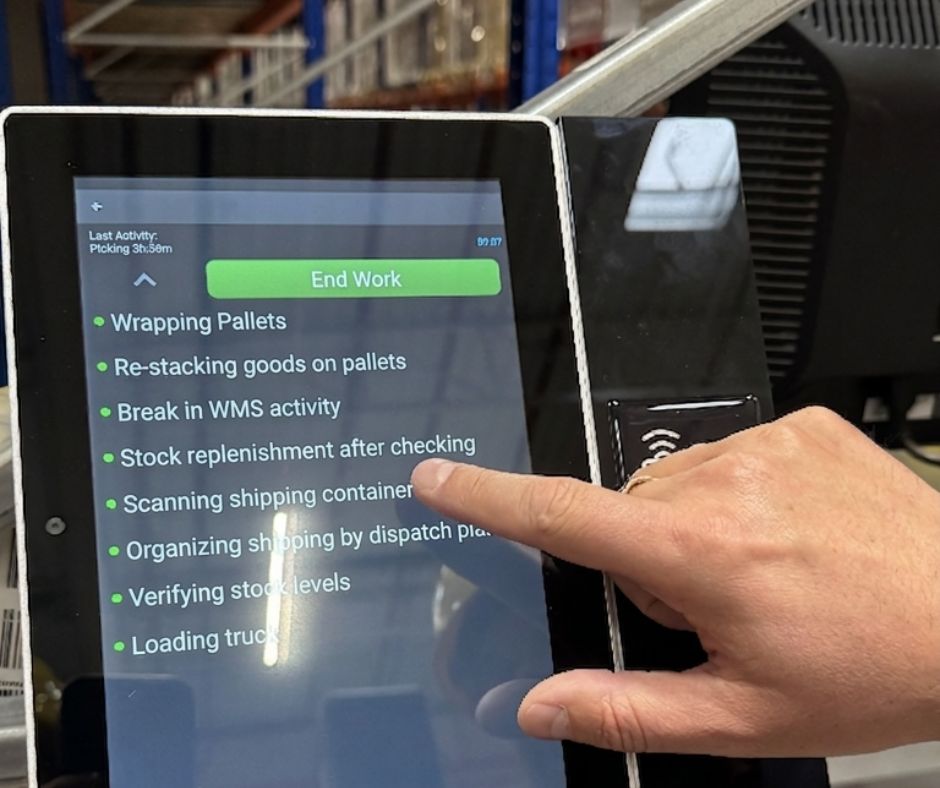
While standard Warehouse Management Systems (WMS) excel at inventory tracking, they often fail to analyze human labor in dynamic conditions. Time Harmony bridges this gap by merging "scanner data" (directly from the WMS) with precise registration of non-scanning activities via proprietary Time Harmony terminals.

The revolution lies in how this data is filtered through activity norms. We recognize that a warehouse is a living organism:

  • Picking in a high-bay zone with long travel paths cannot share the same activity norm as picking in a small pick-face.
  • Unloading a standard trailer differs drastically from handling a LTL delivery, requiring a completely different time-per-activity norm.
  • Even aisle cleaning (a non-scanner task) has its own specific activity norm based on the warehouse zone.

With Time Harmony, these variables shift from guesswork to parameters. By differentiating activity norms based on operational conditions, you can abandon misleading averages and truly evaluate warehouse efficiency.

📌 Precise differentiation of activity norms based on operational conditions allows for a departure from averaged metrics, enabling a true assessment of warehouse labor efficiency.

Data granularity: 15 filters that define your activity norms

The latest Time Harmony update is a milestone toward "mathematical justice" in performance appraisal. We have expanded our filter structure to allow for incredibly precise activity norms.

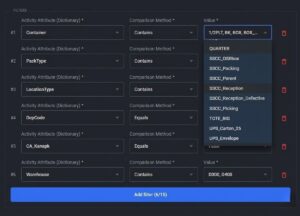
In practical management terms, every activity norm in the system can now be dependent on up to 15 independent conditions simultaneously, including:

  1. Packaging & container type: Different norms for cartons vs. bulky items.
  2. Warehouse zone & location type: Factoring in travel distance and storage specifics.
  3. Unit complexity (The "Sandwich" pallet): The system recognizes "mix" pallets and automatically assigns a higher activity norm.
  4. Multiselect: Assigning one activity norm to entire groups of parameters, eliminating configuration chaos while maintaining precision.

The intelligent matching engine works from "specific to general." If an activity meets the criteria for several norms, the system automatically selects the most specific one. This ensures managers receive data cleaned of errors caused by process complexity.

📌  Expanding the number of filters to 15 conditions enables the construction of activity norms that reflect the actual complexity of warehouse operations, without reducing processes to a lowest common denominator.
advanced activity norms

Dashboards: your operational command cockpit

High-precision activity norms power Time Harmony dashboards, which are configured to meet specific management goals:

  • Time & availability analytics: Clean data on working time, lateness, and breaks.
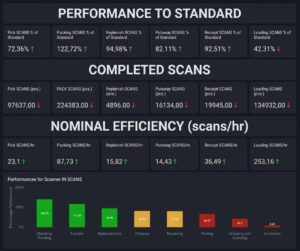
  • High-resolution performance: Key operations (picking, packing) compared against activity norms that account for product attributes. Hourly visibility allows for "here and now" reactions.
  • Declared activities (non-ccanner): This is where Time Harmony is unique. Whether it’s truck unloading or machine maintenance—if it can be measured, the system assigns a specific activity norm. If not, it provides precise data on the time cost of these tasks.
📌  Dashboards in Time Harmony serve as an operational decision center, bridging the gap between labor time data and actual process productivity.
Management dashboard with scanner activities

Strategy & retrospect: leveraging historical data

While "Live" dashboards allow for immediate reaction, the Historical Reporting Module provides the foundation for strategic optimization. True efficiency is born from deep-dive analysis of how activity norms are met over weekly, monthly, or quarterly trends.

Historical data analysis enables:

  • Bottleneck identification: Pinpointing whether a drop in efficiency is due to staffing or the failure to meet specific activity norms.
  • Objective benchmarking: Comparing shifts or teams based on the same rigorous activity norms, eliminating subjectivity.
  • Resource planning: Accurately forecasting staffing needs based on real-world activity norms during peak seasons.
📌  Historical data in Time Harmony transforms real-time measurement into a strategic management tool based on measurable trends.

Actionable analytics: reports that eliminate guesswork

  1. Worker performance report: Compares employees against identical activity norms (e.g., cold store picking), ensuring those who got "easy" orders aren't unfairly rewarded.
  2. Declared activity efficiency report: A breakdown of time spent on tasks like cleaning, measured against specific activity norms to give you control over 100% of the team's time.
  3. "Golden Hour" Analysis: An hour-by-hour fluctuation report to detect natural energy dips and adjust activity norms or station rotation.

What does Time Harmony mean for your business?

  • Precision over Averaging: 15 filters match the activity norm to the real difficulty of the task.
  • Full Transparency: Monitor non-scanner activities via dedicated activity norms.
  • Fair Appraisals: The intelligent engine protects data integrity by choosing the most accurate activity norm for every task.

Ready to see how advanced activity norms can transform your warehouse performance? Book a free consultation with our operational analyst today.

cta_2025

Easily manage your company's working time

Featured Image

Real-time warehouse performance management. Why your KPIs are lying to you?

Most logistics managers base their decisions on historical reports from BI systems or Excel spreadsheets that reflect yesterday's operations. They see that OTIF has dropped, costs per order have risen, and packing efficiency was lower than expected. However, in the dynamic world of e-commerce, static data is not enough. The key to success is real-time warehouse performance management, which allows for a reaction the moment a problem arises—not when it’s already too late to save the day's result.

📌 Reliance on lagging indicators only serves to document inefficiency. Real-time data shifts the manager's role to active process control, allowing for hit-rate optimization and eliminating the need for unplanned overtime.

The "Average efficiency" trap

Many managers focus on LPH (Lines Per Hour) as a monthly or shift-based average. This is a mistake. An 8-hour average can hide dramatic downtime and sudden spikes in workload. If your picking is hitting record numbers in the morning while the packing zone stands idle, unable to process the volume—you are losing money. You are creating a bottleneck, blocking floor space, and generating unnecessary stress. The real challenge isn't the maximum speed of a single zone, but the harmonization of flow between them.

📌 Cost-efficiency depends on flow synchronization, not the record-breaking performance of a single section. Overproduction in picking—without correlation to packing capacity—creates Work-in-Process (WIP) bottlenecks, locking human resources where they fail to generate a finished parcel.

Why real-time warehouse performance management is a must?

In e-commerce, where every minute counts toward the carrier cut-off time, relying on historical data is like driving a car with a blacked-out windshield. To truly control operations, you need insight into parameters that allow for proactive decisions:

  • B2C OTIF (On-Time In-Full): Calculated for specific shipping windows. Will orders placed by 12:00 PM leave the warehouse by 2:00 PM?
  • Order Cycle Time: This is the heartbeat of your warehouse. If the time from order placement to courier handover starts to climb during a shift, your system is losing capacity.
  • LPH per Zone and Process: Knowing how efficiency splits between Single-Order vs. Multi-Order allows for immediate reallocation of staff to emerging bottlenecks.
  • Productivity per FTE: Answers the vital question: "Do we have the optimal number of people today relative to the actual order flow?"
📌 Real-time monitoring of 'Order Cycle Time' detects declining profitability before it hits the bottom line. It enables immediate staff reallocation, optimizing labor costs and guaranteeing SLA compliance without the need for additional resources.

From dashboard to decision: the role of Time Harmony

Logistics management is, in reality, tempo management. KPIs without the ability to react instantly are just statistics. The Time Harmony system was designed to turn static data into dynamic action, enabling full control over the process here and now.

How does it work in practice?

  1. Detect bottlenecks before they block you: If packing can’t keep up with picking, the system alerts you immediately, not at the end of the shift.
  2. Harmonize shift work: Instead of moving people "by gut feeling," you reallocate resources based on hard data regarding zone load and FTE availability.
  3. Proactively manage the backlog: You know exactly how many orders are waiting and what decision to make to save delivery deadlines before the courier arrives.

Summary: Logistics needs a metronome

In modern e-commerce, the winner isn't the one with the most data, but the one who can interpret and translate it into labor or process movement the fastest. If your KPIs only serve to create pretty presentations for the board, you are missing an opportunity for cost optimization. It’s time to stop analyzing what broke yesterday and start setting the rhythm for today.

📌 Implementing Time Harmony eliminates decision-making errors caused by intuitive 'gut-feeling' management. Full work measurability stabilizes processes and guarantees the predictability of operational costs, even amidst high volume fluctuations.

Want to see real-time warehouse performance management in action? Discover how Time Harmony helps you manage efficiency and labor time, turning chaos into a predictable rhythm. Contact us! 


czas pracy

Optimize working time and efficiency of your team

Featured Image

Modern work time settlement automation: What does the TimeHarmony 3.15.0 update bring?

Effective and reliable work time settlement automation is a process that requires constant refinement of digital tools to meet the dynamic needs of the market. Until now, we shared key updates with our registered users primarily via newsletters. However, we have decided to introduce an additional communication channel – regular blog posts published with every new update.

Our goal is to build a comprehensive knowledge base that not only informs you about new features but also explains their practical application in everyday human capital management.

The current system update to version 3.15.0 (scheduled for import this Thursday, February 19, 2026) focuses on two major innovations: mass import of absence limits and advanced private leave reporting. Furthermore, we are introducing several UI and functional enhancements designed to improve ergonomics, data clarity, and operational precision.


How version 3.15.0 supports work time settlement automation in your company

Comprehensive private leave management

Modern work styles demand flexibility, but also full transparency in attendance records. Last December, we enhanced TimeHarmony with the ability to register private errands and their subsequent "make-up" hours.

While labor laws don't always create a separate category for such absences, they do indicate that leaving the workplace without consent can be a breach of duty. In practice, this means such events must be formally reported and approved. This is where systems capable of handling private leave in an organized, compliant manner become essential.

With this update, we are expanding this module with a dedicated private leave and make-up time report. This tool automates the process of monitoring whether the time taken off has been fully worked back.

  • Intelligent pairing: The system matches leave requests with corresponding make-up slots.
  • Visual balance: Using conditional formatting in Excel (green for a full balance, red for remaining hours), the settlement status is visible at a glance.
  • Real-time data: Reports are generated based on currently approved requests.
📌 Goal of the change: To organize private leave records in compliance with the law and fully automate the monitoring of worked-back hours.


Mass import of absence limits: speed and precision

For organizations that do not use automatic synchronization of holiday limits from external HR and payroll systems, we have introduced a significant improvement. You can now mass upload absence limits directly into employee profiles using the import function.

  • Data Scope: Precisely assign the number of days or hours for specific types of absences.
  • Parameters: The system supports user and absence mapping keys and allows you to define how limits are calculated based on the FTE (full-time equivalent).
  • Error handling: Choose to overwrite or skip existing records during the import process.
📌 Goal of the change: To eliminate manual data entry, drastically reducing the time needed to prepare the system for a new calendar or settlement year.


Interface enhancements and analytical functions

Version 3.15.0 also includes a series of changes to improve daily user experience:

  • Improved Table Readability: With the new HeaderCellWithTooltip feature, hovering over long column names reveals the full text in a tooltip. No more manual column resizing.
  • Dynamic Widget Adjustment: The user dashboard now features automatic height calculation. The system optimizes screen space by intelligently selecting the number of displayed items.
  • Reports as Email Attachments: We’ve restored the option to receive reports directly in your inbox. The system calculates the total file weight (up to 20 MB) and automatically decides whether to send them as an attachment or a secure download link.
  • Task Monitoring: The "Employees in Activities" widget now includes a multi-select option, allowing managers to filter the view for specific, high-priority tasks.
  • Advanced Norm Configuration: We have expanded the norm definition module to support up to 15 independent filters. This allows for precise data mapping from external systems (e.g., WMS), such as packaging type, container type, or warehouse zone.
📌 Goal of the change: To increase ergonomics, improve interface aesthetics, and provide more powerful analytical tools for complex operational environments.


Time Harmony – reliability and labor law compliance

Time Harmony is a professional solution designed for precise, reliable, and fully compliant work time planning and settlement. In today’s business world, attendance tracking is just the beginning – the real value lies in work time settlement automation combined with activity tracking and performance measurement.

By assigning specific norms to tasks, our clients gain not only proof of fair settlement but also powerful analytical data. Measuring efficiency allows you to identify process bottlenecks, optimize labor costs, and build fair incentive systems. We believe that every update, including version 3.15.0, brings you closer to peak operational efficiency.

 👉 Ready to see how the new features in Time Harmony can streamline your business? Contact our support team at support@timeharmony.pl or explore the new options directly in the system!


czas pracy

Optimize working time and efficiency of your team

Featured Image

Labor Inspection: 5 critical risks and how to avoid them

Compliant with Polish Labour Law

For many entrepreneurs, keeping working time records is seen merely as a burdensome administrative task. However, from the perspective of the National Labor Inspectorate (PIP), it is one of the most critical documents in a company.

A labor inspection uses these records as a "roadmap" to determine whether an employer correctly calculates working hours and ensures employees receive their legally mandated rest periods.

Errors in working time records can be costly. According to Article 281 of the Labor Code, violations of working time regulations carry fines ranging from 1,000 PLN to 30,000 PLN. In extreme cases, if an inspector finds evidence of record falsification, criminal liability may also apply (Article 271 of the Penal Code).

Below are the 5 areas that most frequently lead to sanctions during an audit and how modern tools—such as Time Harmony—help mitigate these risks.

1. The working day vs. labor inspection – when a "normal hour" becomes overtime

Most irregularities found during inspections stem from a misunderstanding of the "working day". According to the Labor Code, a working day consists of 24 consecutive hours starting from the moment an employee begins work, not from midnight (0:00).

 The Excel risk

If an employee starts work at 8:00 AM on Monday, their "working day" lasts until 8:00 AM on Tuesday. If they start at 7:00 AM on Tuesday, the hour from 7:00 to 8:00 AM automatically becomes daily overtime from the previous day. Excel spreadsheets often fail to catch this, treating it as a standard hour.

Financial consequence
An inspector will classify this as a failure to pay overtime bonuses (50% or 100%), which is a material violation rather than a mere formal error.

The Time Harmony solution
The system includes a working day control mechanism that blocks the approval of schedules violating this rule. If a clock-in occurs earlier than allowed by system settings, the software automatically flags that time as daily overtime.

📌 During an inspection, the "plan" doesn't matter; the actual distribution of hours does. Automatic control eliminates one of the most common and expensive errors.

2. Daily (11 hours) and weekly (35 hours) rest periods

Providing minimum rest periods is a fundamental employer obligation. During audits, inspectors cross-reference working time records with real employee entry and exit times.

Common error
An employee finishes work at 10:00 PM and starts at 7:00 AM the next day. This constitutes a violation of the mandatory 11-hour uninterrupted daily rest period.

Consequences of inspection
Permanent violations of rest norms are judged severely. Fines often exceed 10,000 PLN because labor authorities view this area as directly linked to employee health and safety.

How Time Harmony helps
 The system generates alerts during the planning stage and flags instances where an employee's actual card swipe indicates a shortened rest period.

📌  For labor inspectors, the lack of preventative mechanisms is a red flag. System alerts prove that the employer is actively managing compliance risks.

3. Data inaccuracy vs. audit logs

Companies using paper records or Excel often fail the "credibility test." Perfectly uniform working hours (e.g., 8:00 AM – 4:00 PM every day) are a warning signal to an inspector.

Why Excel is a liability
The ability to edit data without leaving a trace undermines the reliability of records. Increasingly, inspectors check not just the content, but when the data was entered and the history of changes.

The digital audit log
Advantage In Time Harmony, every change is recorded: you can see who made the edit, when, and why. This history increases document credibility and proves that corrections are part of a controlled process.

📌  A lack of change history works against the employer. An audit log is proof of diligence, not a sign of weakness.

4. Overtime limits – beyond the 150-hour annual cap

Many managers focus solely on the 150-hour annual overtime limit, neglecting the weekly limit—an average of 48 hours total (including overtime) within the settlement period.

Organizational risk
Violations are often only discovered during an inspection when it is too late to make corrections.

How to reduce risk?
Time Harmony provides managers with a real-time view of overtime usage, allowing them to monitor limits as they happen rather than after the fact.

📌 Inspections frequently reveal "unnoticed" overtime. Continuous monitoring is more effective than post-facto accounting.

5. Arbitrary rounding of working time

"Rounding to the nearest quarter-hour" is a common practice that is illegal if it works to the employee's disadvantage.

The Excel Risk Spreadsheet formulas often automatically round 8:03 AM to 8:00 AM or 3:55 PM to 4:00 PM. For an inspector, this is a textbook example of data manipulation. The sum of "shaved" minutes across a whole month for dozens of employees can result in substantial unpaid overtime.

Financial impact
An order to pay back wages with interest for up to 3 years, plus high fines for unreliable record-keeping.

The Time Harmony advantage
 The system manages this through two precise features:

  1. Time Rounding: Administrators define fixed rules (e.g., to the nearest 5, 10, or 15 minutes). The key is symmetry—ensuring the process is transparent and compliant with internal work regulations.
  2. Time Smoothing: This manages margins for arrivals, departures, or permissible delays. It separates actual work time from technical time (e.g., changing clothes), providing a solid argument during an audit.


Summary: How to prepare for a labor inspection

To ensure your working time records aren't questioned, they must be:

  1. Accurate – reflecting actual time worked.
  2. Up-to-date – maintained in real-time.
  3. Accessible – ready to be presented at any moment.

For larger teams, Excel stops being a tool and starts becoming a risk. Time Harmony acts as an early warning system, allowing you to identify irregularities before a labor inspector does.

cta_2025

Easily manage your company's working time

Featured Image

Good Friday public holiday 2026 in Poland - what we know so far?

Compliant with Polish Labour Law

Good Friday public holiday 2026 – what the petition in the polish parliament means for employers, hr, and employees

The topic of Good Friday public holiday 2026 is increasingly appearing in public debate, especially after the introduction of a free Christmas Eve. At the end of 2025, a petition was submitted to the Polish Parliament proposing a change to the law on public holidays and establishing Good Friday as a statutory day off. For employers, managers, and HR departments, this highlights the need to monitor potential changes that could affect work planning and time tracking in 2026.

Below, we analyze whether Good Friday as a public holiday in 2026 is realistic, the legal and organizational arguments, and how companies can prepare for possible changes.


Good Friday public holiday 2026 and current labor law

Under current regulations, the situation is clear: Good Friday is not included in the official list of statutory public holidays defined in the Act of January 18, 1951. This means that:

  • Good Friday is treated as a regular working day,
  • Employees can take annual leave or unpaid leave,
  • Employers may introduce internal solutions (e.g., shortened working hours), but there is no legal obligation.
📌 Until the law changes, Good Friday as a public holiday in 2026 remains a proposal, not an employer obligation.


Petition in parliament – does Good Friday public holiday 2026 have a chance?

The petition submitted in autumn 2025 concerns an amendment to the law on public holidays to include Good Friday in the official list. The Petition Committee can:

  • Recognize the proposal as valid and forward it for further legislative work,
  • Reject the petition,
  • Leave it without further action.

Currently, there is no draft law or schedule of parliamentary work, which is crucial for assessing whether a Good Friday public holiday 2026 is realistic.

📌  The lack of a formal legislative initiative means employers should not plan 2026 as if Good Friday were a public holiday.


Organizing work on Good Friday – real company challenges

Regardless of whether Good Friday becomes a statutory day off, the day already presents organizational challenges:

  • Schools are closed while parents still need to work,
  • Increased leave requests are observed,
  • Some companies operate in a limited capacity,
  • In some cities, public transport follows holiday schedules.

For employers, this reduces predictability in workforce availability, especially in retail, logistics, and service sectors.

📌  Even without a statutory holiday, Good Friday requires careful planning of working hours and staffing.


Good Friday public holiday 2026 in the EU context

One of the petition’s key arguments is that Good Friday is a public holiday in many EU countries, in addition to Easter Monday. It is increasingly pointed out that:

  • Comparing the number of public holidays “on paper” can be misleading,
  • In Poland, some holidays always fall on Sundays,
  • The actual number of days off is lower than commonly assumed.

From a labor market perspective, these arguments are gaining traction even among employers.

📌  Pressure to harmonize with the European market may keep the topic of Good Friday on the agenda – even if not in 2026.


Is Good Friday public holiday 2026 in Poland realistic?

From a legislative perspective, it is unlikely. For Good Friday to become a statutory holiday in 2026, it would require:

  • Fast parliamentary proceedings,
  • Adoption of an amendment,
  • Appropriate vacatio legis,
  • Adjustment of HR systems and work schedules.

Experience with the introduction of a free Christmas Eve shows that such changes require time and preparation.

📌  The most realistic scenario is potential changes from 2027 onward.


Time Harmony and work planning amid legal changes

Potential expansion of public holidays, such as Good Friday as a statutory day off, always affects:

  • Work time limits,
  • Settlement periods,
  • Schedules,
  • Overtime calculations.

The Time Harmony system supports companies in professional, compliant work time planning and reporting by enabling:

  • Automatic recognition of public holidays,
  • Quick adjustment of schedules to legal changes,
  • Compliance monitoring with labor law standards.
📌  In uncertain legislative conditions, having a system that allows safe and accurate reactions to changes is critical – minimizing HR errors.


Summary for employers and HR

Currently, Good Friday as a public holiday in 2026 is a proposal, not a legal obligation. However, growing social expectations and the precedent of free Christmas Eve suggest that the topic should be considered in long-term planning.

📌  Companies that already optimize work time planning and reporting will be prepared for Good Friday 2026 and any future changes in labor law.
cta_2025

Easily manage your company's working time

th_logo_wh

©

2023 P2P2 Sp. z o.o. I Wszystkie prawa zastrzeżone