Beyond averages. How advanced activity norms drive warehouse excellence
Scaling logistics operations requires the precise calibration of every single workflow stage. The key to gaining a competitive edge is not just data collection, but its contextual interpretation. The belief that every unloading process takes the same amount of time, or that every pallet requires an identical workload, is a trap that masks real bottlenecks.
The Time Harmony system has evolved from a monitoring tool into a powerful analytical engine. Thanks to this evolution, the correlation between advanced activity norms and warehouse labor productivity is no longer just a theoretical assumption—it has become a high-precision management tool. The latest update to the norms module allows for measuring efficiency with unprecedented accuracy.
Precision process calibration. Advanced activity norms and warehouse labor productivity.
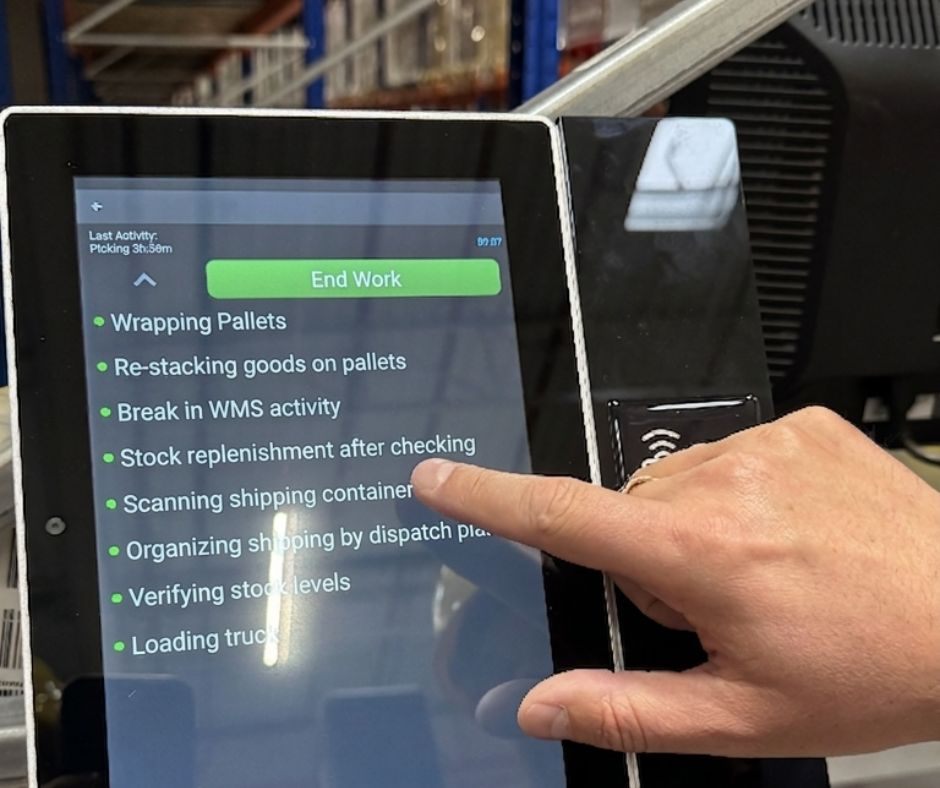
While standard Warehouse Management Systems (WMS) excel at inventory tracking, they often fail to analyze human labor in dynamic conditions. Time Harmony bridges this gap by merging "scanner data" (directly from the WMS) with precise registration of non-scanning activities via proprietary Time Harmony terminals.
The revolution lies in how this data is filtered through activity norms. We recognize that a warehouse is a living organism:
- Picking in a high-bay zone with long travel paths cannot share the same activity norm as picking in a small pick-face.
- Unloading a standard trailer differs drastically from handling a LTL delivery, requiring a completely different time-per-activity norm.
- Even aisle cleaning (a non-scanner task) has its own specific activity norm based on the warehouse zone.
With Time Harmony, these variables shift from guesswork to parameters. By differentiating activity norms based on operational conditions, you can abandon misleading averages and truly evaluate warehouse efficiency.
Data granularity: 15 filters that define your activity norms
The latest Time Harmony update is a milestone toward "mathematical justice" in performance appraisal. We have expanded our filter structure to allow for incredibly precise activity norms.
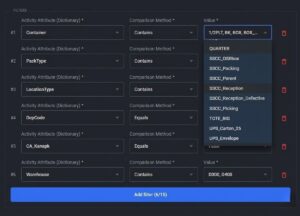
In practical management terms, every activity norm in the system can now be dependent on up to 15 independent conditions simultaneously, including:
- Packaging & container type: Different norms for cartons vs. bulky items.
- Warehouse zone & location type: Factoring in travel distance and storage specifics.
- Unit complexity (The "Sandwich" pallet): The system recognizes "mix" pallets and automatically assigns a higher activity norm.
- Multiselect: Assigning one activity norm to entire groups of parameters, eliminating configuration chaos while maintaining precision.
The intelligent matching engine works from "specific to general." If an activity meets the criteria for several norms, the system automatically selects the most specific one. This ensures managers receive data cleaned of errors caused by process complexity.
Dashboards: your operational command cockpit
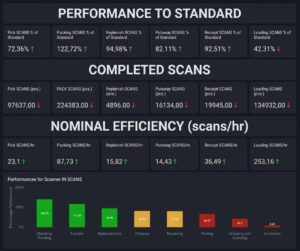
High-precision activity norms power Time Harmony dashboards, which are configured to meet specific management goals:
- Time & availability analytics: Clean data on working time, lateness, and breaks.
- High-resolution performance: Key operations (picking, packing) compared against activity norms that account for product attributes. Hourly visibility allows for "here and now" reactions.
- Declared activities (non-ccanner): This is where Time Harmony is unique. Whether it’s truck unloading or machine maintenance—if it can be measured, the system assigns a specific activity norm. If not, it provides precise data on the time cost of these tasks.
Strategy & retrospect: leveraging historical data
While "Live" dashboards allow for immediate reaction, the Historical Reporting Module provides the foundation for strategic optimization. True efficiency is born from deep-dive analysis of how activity norms are met over weekly, monthly, or quarterly trends.
Historical data analysis enables:
- Bottleneck identification: Pinpointing whether a drop in efficiency is due to staffing or the failure to meet specific activity norms.
- Objective benchmarking: Comparing shifts or teams based on the same rigorous activity norms, eliminating subjectivity.
- Resource planning: Accurately forecasting staffing needs based on real-world activity norms during peak seasons.
Actionable analytics: reports that eliminate guesswork
- Worker performance report: Compares employees against identical activity norms (e.g., cold store picking), ensuring those who got "easy" orders aren't unfairly rewarded.
- Declared activity efficiency report: A breakdown of time spent on tasks like cleaning, measured against specific activity norms to give you control over 100% of the team's time.
- "Golden Hour" Analysis: An hour-by-hour fluctuation report to detect natural energy dips and adjust activity norms or station rotation.
What does Time Harmony mean for your business?
- Precision over Averaging: 15 filters match the activity norm to the real difficulty of the task.
- Full Transparency: Monitor non-scanner activities via dedicated activity norms.
- Fair Appraisals: The intelligent engine protects data integrity by choosing the most accurate activity norm for every task.
Ready to see how advanced activity norms can transform your warehouse performance? Book a free consultation with our operational analyst today.
Easily manage your company's working time