During this year's Smart Warehouse 2026 conference, a report was premiered that should become mandatory reading for every operational manager and logistics director. We are talking about the third edition of the study "Where are you heading, Logistics? 2026 Edition," developed by experts from ManpowerGroup and the American Chamber of Commerce in Poland, focusing directly on the Polish market.
Both the report itself and the engaging panel discussions lead to one incredibly powerful conclusion: Polish logistics finds itself gripped by rising costs and a demographic gap. However, the key to solving these problems lies in a completely different place than most companies think. The technological arms race on the Polish logistics market will be won not by those who blindly buy the most expensive robots, but by those who focus on warehouse labor efficiency based on reliable data.
Market optimism in Poland in the shadow of intense competition
The logistics sector in Poland holds a strong position – as many as 7 out of 10 surveyed companies consider it well-developed compared to other European markets, and 75% rate Poland's attractiveness for new logistics investments very highly. What is more, development prospects for the Polish market are promising: as many as 69% of respondents expect further growth of the sector in the coming years, and this optimism is confirmed by financial forecasts. Only 2% of organizations in Poland do not assume revenue growth in the current year (which represents a massive improvement compared to 2025, when 18% of respondents declared no growth). The most dynamic development, meaning revenue growth exceeding 50%, is expected by 7% of organizations.
Logistics labor costs are rising in Poland, but what about productivity?
Finances are the main driving force behind changes in the industry. According to the report, as many as 60% of organizations in Poland consider rising staff recruitment costs to be a serious or very serious problem. Panel discussion participants directly pointed out that personnel costs are currently the fastest-growing factor in the structure of operating expenses within Polish logistics. This is hardly surprising, given that logistics generates heavy burdens for a significant part of the market: for 38% of the surveyed companies, logistics costs account for 5% to 10% of sales value, and for another 20% of organizations, this ratio reaches between 10% and 20%.
Recruiting new ones is becoming a monumental challenge. Over the last 6 months, logistics companies in Poland have collided hardest with the shortage of labor for key executive positions: as many as 88% of companies declare immense difficulties in acquiring forklift and machine operators, and 72% in filling driver positions. Finding freight forwarders (51% of indications) and unskilled manual workers (48%) is also becoming a major issue on the local market.
How do skill gaps and new HR strategies affect warehouse labor efficiency?
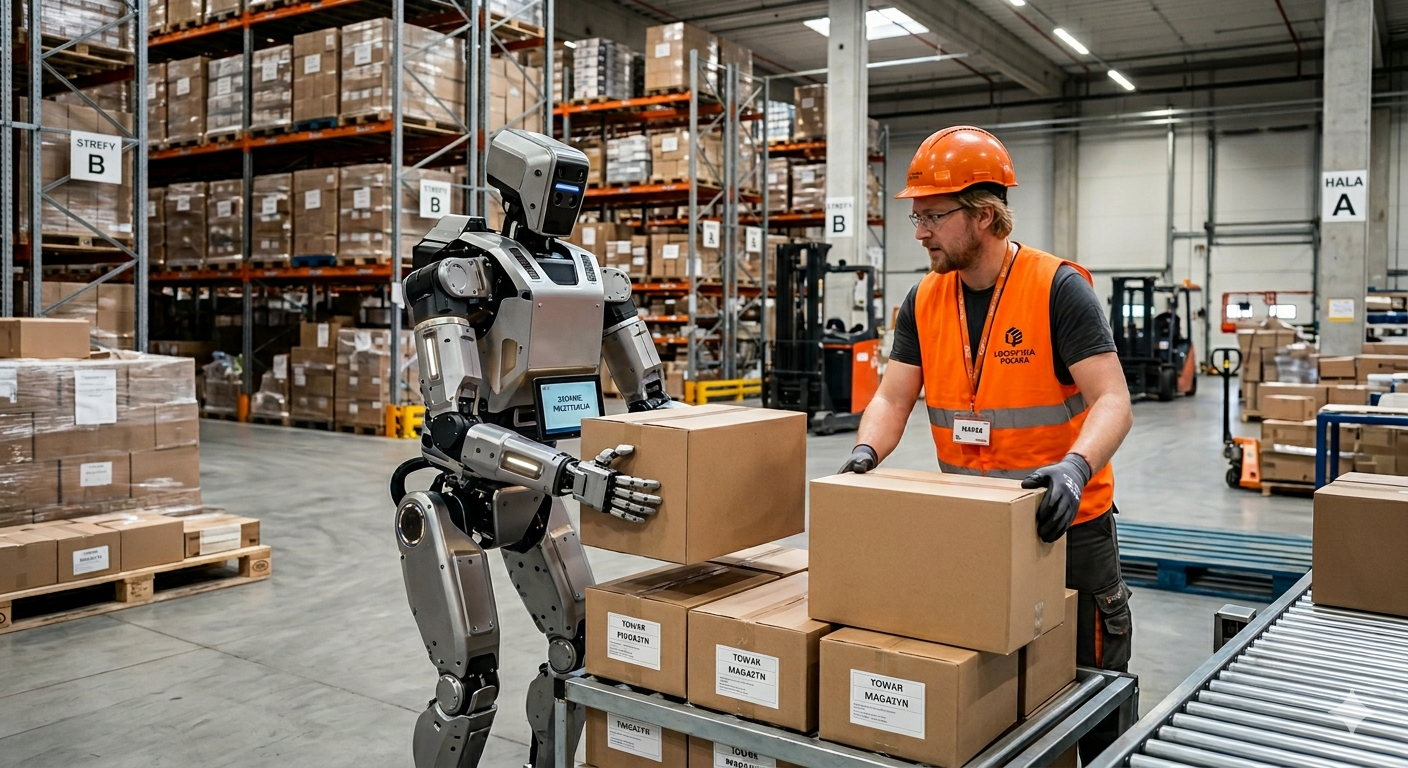
The automation of warehouse processes seems to be the Polish market's natural response. As many as 58% of logistics companies plan to invest in automation and robotics in the coming years, and 43% want to implement these solutions directly within warehouse processes. At this point, however, a fundamental question must be asked: are our organizations ready for a robot to stand in the warehouse and work shoulder to shoulder with a human?
Most managers forget the golden rule of intralogistics: automating chaos only results in automated chaos. If the processes in the warehouse are unorganized, work standards are unclear, and the flow of information breaks down at every step, implementing expensive AGVs/AMRs or picking robots will only generate massive costs without bringing the expected return on investment (ROI). The Polish logistics industry still has a major lesson to learn when it comes to mastering process chaos. Before we hand warehouses over to machines, we must optimize what we have today to improve warehouse labor efficiency.
Humans at the heart of logistics – how to increase team productivity?
Despite the galloping development of artificial intelligence (AI), advanced analytics, and automation, humans will remain the heart of logistics for many years to come. Since human resources on the Polish labor market are limited, the only way to maintain profit margins is through good work organization and constantly raising the productivity of the current team.
To achieve this, three elements are essential:
- Monitoring the correct flow of processes and eliminating bottlenecks (wasted time).
- Reliably tracking employee performance to ensure fair evaluation and team motivation.
- Working with the data provided by modern systems.
Lessons from implementations: Data needs a leader, and recruitment needs redefining
Our long-term implementation experience within the Polish logistics market reveals a clear pattern: an IT system by itself will not fix a business. Real optimization processes occur only when a dedicated data coordinator is appointed within the organizational structure.
When a team regularly analyzes system reports, it can precisely identify which warehouse zones generate delays, when employees lose the most time on "empty runs", and how to effectively plan staffing across shifts to maximize warehouse labor efficiency.
Interestingly, the report shows that companies in Poland are beginning to notice internal gaps. The largest deficits among current logistics employees relate precisely to analytical skills (indicated by 40% of organizations) and soft skills (36%). To acquire these necessary skills and successfully fight the talent shortage, organizations are abandoning passive waiting for ideal candidates and shifting their personnel strategies.
In 2026, the key actions taken by companies in Poland to build competencies are:
- Training and upskilling (44%): Raising the qualifications of current employees within their existing roles.
- Reskilling (39%): Comprehensive retraining and deploying teams to entirely new tasks.
- Digitalization and automation (28%): Technological implementations aimed directly at reducing the demand for scarce workers (an increase from just 14% in the previous year!).
- Employment flexibility: As many as 42% of companies use part-time employment, and 37% utilize temporary work.
Flexible forms of employment are no longer treated as a last resort, but are becoming a strategic tool. Nearly 60% of organizations declare that they increase operational flexibility, and 52% claim they allow for better adjustment of labor resources to changing needs. Almost every second company (49%) also notes that flexibility makes it easier to acquire and retain qualified employees during a labor market crisis in Poland.
How Time Harmony supports warehouse labor efficiency
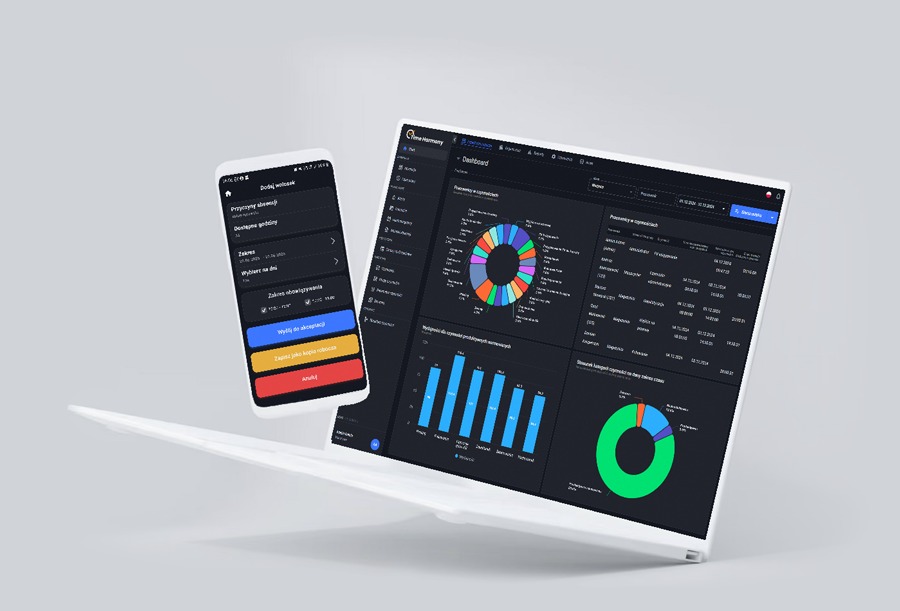
These exact mechanisms form the foundation of the philosophy and architecture of the Time Harmony system. When we implement our solution in logistics centers across Poland, we do not just give companies another complicated IT tool they do not know what to do with. We give them transparency and control over HR and operational processes.
Wherever the Time Harmony system is operational, warehouse labor efficiency grows because:
- We uncover hidden potential: Management gains access to reliable, unaltered data regarding actual working time and the efficiency of task execution by individual workers.
- We eliminate process chaos: Coordinators and shift supervisors can monitor the team's work in real time and react immediately to deviations from the norm.
- We build a foundation for the future: Organizing processes and boosting human productivity by a dozen or several dozen percent is the best (and cheapest) way to fight cost pressures. Only on such prepared, "clean" ground can you safely consider deploying robots.
Rising labor costs in logistics are a fact that we cannot beat with methods of the past. Instead of waiting for a technological revolution, it is worth starting with the optimization of the team you have at your disposal today. Reliable analytics and a system that turns chaos into profit will help you achieve this.
Want to know how much time is being wasted in your logistics center and how modern solutions can immediately boost warehouse labor efficiency? Contact us and check out the capabilities of the Time Harmony system.
Optimize working time and efficiency of your team