
For many entrepreneurs, keeping working time records is seen merely as a burdensome administrative task. However, from the perspective of the National Labor Inspectorate (PIP), it is one of the most critical documents in a company.
A labor inspection uses these records as a "roadmap" to determine whether an employer correctly calculates working hours and ensures employees receive their legally mandated rest periods.
Errors in working time records can be costly. According to Article 281 of the Labor Code, violations of working time regulations carry fines ranging from 1,000 PLN to 30,000 PLN. In extreme cases, if an inspector finds evidence of record falsification, criminal liability may also apply (Article 271 of the Penal Code).
Below are the 5 areas that most frequently lead to sanctions during an audit and how modern tools—such as Time Harmony—help mitigate these risks.
1. The working day vs. labor inspection – when a "normal hour" becomes overtime
Most irregularities found during inspections stem from a misunderstanding of the "working day". According to the Labor Code, a working day consists of 24 consecutive hours starting from the moment an employee begins work, not from midnight (0:00).
The Excel risk
If an employee starts work at 8:00 AM on Monday, their "working day" lasts until 8:00 AM on Tuesday. If they start at 7:00 AM on Tuesday, the hour from 7:00 to 8:00 AM automatically becomes daily overtime from the previous day. Excel spreadsheets often fail to catch this, treating it as a standard hour.
Financial consequence
An inspector will classify this as a failure to pay overtime bonuses (50% or 100%), which is a material violation rather than a mere formal error.
The Time Harmony solution
The system includes a working day control mechanism that blocks the approval of schedules violating this rule. If a clock-in occurs earlier than allowed by system settings, the software automatically flags that time as daily overtime.
2. Daily (11 hours) and weekly (35 hours) rest periods
Providing minimum rest periods is a fundamental employer obligation. During audits, inspectors cross-reference working time records with real employee entry and exit times.
Common error
An employee finishes work at 10:00 PM and starts at 7:00 AM the next day. This constitutes a violation of the mandatory 11-hour uninterrupted daily rest period.
Consequences of inspection
Permanent violations of rest norms are judged severely. Fines often exceed 10,000 PLN because labor authorities view this area as directly linked to employee health and safety.
How Time Harmony helps
The system generates alerts during the planning stage and flags instances where an employee's actual card swipe indicates a shortened rest period.
3. Data inaccuracy vs. audit logs
Companies using paper records or Excel often fail the "credibility test." Perfectly uniform working hours (e.g., 8:00 AM – 4:00 PM every day) are a warning signal to an inspector.
Why Excel is a liability
The ability to edit data without leaving a trace undermines the reliability of records. Increasingly, inspectors check not just the content, but when the data was entered and the history of changes.
The digital audit log
Advantage In Time Harmony, every change is recorded: you can see who made the edit, when, and why. This history increases document credibility and proves that corrections are part of a controlled process.
4. Overtime limits – beyond the 150-hour annual cap
Many managers focus solely on the 150-hour annual overtime limit, neglecting the weekly limit—an average of 48 hours total (including overtime) within the settlement period.
Organizational risk
Violations are often only discovered during an inspection when it is too late to make corrections.
How to reduce risk?
Time Harmony provides managers with a real-time view of overtime usage, allowing them to monitor limits as they happen rather than after the fact.
5. Arbitrary rounding of working time
"Rounding to the nearest quarter-hour" is a common practice that is illegal if it works to the employee's disadvantage.
The Excel Risk Spreadsheet formulas often automatically round 8:03 AM to 8:00 AM or 3:55 PM to 4:00 PM. For an inspector, this is a textbook example of data manipulation. The sum of "shaved" minutes across a whole month for dozens of employees can result in substantial unpaid overtime.
Financial impact
An order to pay back wages with interest for up to 3 years, plus high fines for unreliable record-keeping.
The Time Harmony advantage
The system manages this through two precise features:
- Time Rounding: Administrators define fixed rules (e.g., to the nearest 5, 10, or 15 minutes). The key is symmetry—ensuring the process is transparent and compliant with internal work regulations.
- Time Smoothing: This manages margins for arrivals, departures, or permissible delays. It separates actual work time from technical time (e.g., changing clothes), providing a solid argument during an audit.
Summary: How to prepare for a labor inspection
To ensure your working time records aren't questioned, they must be:
- Accurate – reflecting actual time worked.
- Up-to-date – maintained in real-time.
- Accessible – ready to be presented at any moment.
For larger teams, Excel stops being a tool and starts becoming a risk. Time Harmony acts as an early warning system, allowing you to identify irregularities before a labor inspector does.
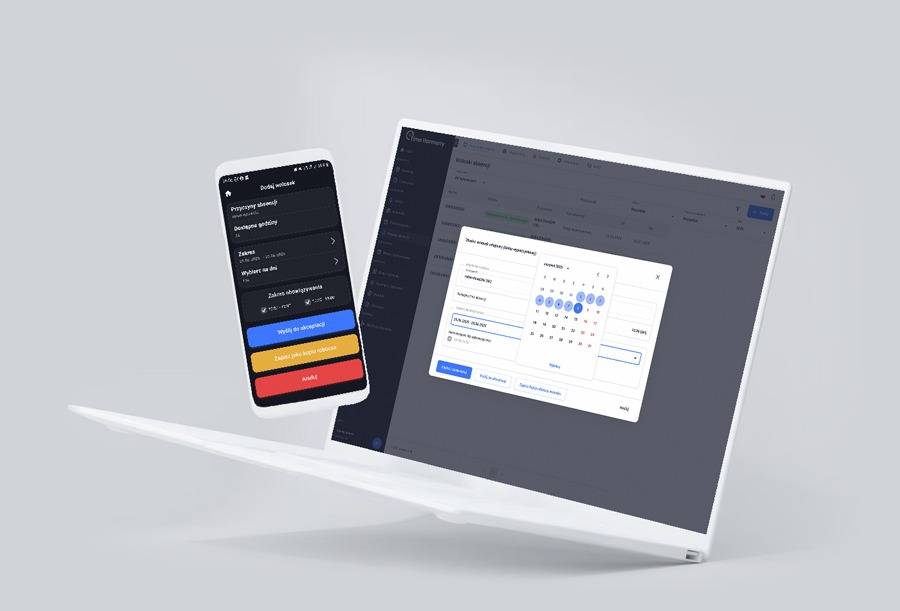
Easily manage your company's working time