
As of July 8, 2026, Poland's National Labour Inspectorate (PIP) can — for the first time — issue an administrative decision declaring that a B2B contract or contract of mandate was, in reality, a sham contract disguising an employment relationship. No court filing required. If your company engages contractors in Poland under B2B agreements, this changes the practical risk calculus: it is no longer enough for the contract to say "B2B" — you need to be able to show how the collaboration actually works day to day. Here is what counts as a sham B2B contract under Polish law, what new powers PIP has gained, and how systematic time and task records can serve as real evidence if an inspection happens.
What makes a B2B contract "sham" under Polish law
The concept of a sham contract is not new — it is a long-standing feature of Polish civil law, and the 2026 reform simply gives labour inspectors a faster way to act on it.
Under Article 83 of the Polish Civil Code, a declaration of intent made to another party with that party's consent, purely for appearances, is void. Applied to B2B collaboration, this describes a situation where both sides sign a B2B contract while never actually intending to operate under the terms typical of a civil-law relationship — from day one, both parties know the arrangement will function like regular employment.
This rule applies directly to labour relations through Article 300 of the Polish Labor Code, and the key reference point is Article 22 § 1, which defines an employment relationship as one where a person:
- performs work personally,
- works under the direction and supervision of the other party,
- has a place and time of work assigned to them,
- and receives remuneration in return.
The Polish Supreme Court settled the underlying principle back in a ruling dated March 26, 2008 (case no. I UK 282/07): what determines the nature of a contract is not its title, but the actual purpose and intent of the parties, and how it is carried out in practice. A document headed "B2B cooperation agreement" offers no protection if the day-to-day reality looks like a regular job.
It's worth stressing what Poland's Ministry of Family, Labour and Social Policy states clearly: the reform does not change the legal definition of an employment relationship or introduce new criteria. Properly structured and properly executed B2B contracts remain fully legal. What changes is how effectively PIP can now detect and act on the ones that were sham from the start.
New Polish labour inspectorate powers from July 2026
The act amending PIP's powers was passed by the Sejm on March 11, 2026, signed by the President on April 2, and published in the Journal of Laws (Dz.U. 2026, item 473). The core provisions took effect on July 8, 2026.
Administrative decision instead of a court case
Previously, reclassifying a civil-law contract into an employment contract required a lawsuit — a slow process that depended on the worker's own initiative. Now, a District Labour Inspector can issue an administrative decision establishing the existence of an employment relationship directly.
The procedure is staged:
- If an inspector identifies irregularities during an audit, they first issue a compliance order — setting a deadline to either sign an employment contract or restructure the terms of cooperation so they genuinely match a civil-law relationship.
- Only if that order is ignored can the inspector request a decision reclassifying the contract as an employment contract.
- Both the company and the worker can appeal to a labor court within 30 days, and filing an appeal suspends enforcement of the decision until a final ruling — except for workers under special legal protection (e.g. trade union representatives, employees nearing retirement age), where immediate enforceability can be granted.
Higher fines and possible backdated liability
Maximum fines for violations of worker rights have doubled, from PLN 30,000 to PLN 60,000, rising to PLN 90,000 for repeat offences. If a reclassification decision is upheld, authorities may also recalculate outstanding social security contributions and taxes up to 5 years back — a materially different (and stricter) outcome than what was floated during the earlier legislative draft stage.
A 12-month transition window — with real limits
Companies that voluntarily bring a civil-law contract into compliance (by signing an employment contract where one is genuinely warranted) by July 8, 2027 are exempt from fines for that period. This "amnesty" is narrower than it sounds: it covers fines tied to the new regulations specifically, not automatically every other consequence of a contested collaboration model (for example, backdated contribution disputes in a live case). Treat the transition period as an audit window, not a blanket shield.
Remote inspections and cross-agency data sharing
PIP can now conduct parts of an inspection remotely — requesting electronic documents, interviewing witnesses online. Data sharing between PIP, ZUS (Social Insurance Institution) and KAS (National Revenue Administration) — including invoice data via KSeF, the national e-invoicing system — allows authorities to flag companies for audit based on data patterns (such as the ratio of employees to contractors on the payroll) before an inspector ever shows up. A report or complaint is a legal basis to open an inspection, and companies are not told who filed it.
Employers can also request an individual interpretation from PIP — similar to tax rulings — to get an advance read on whether a specific collaboration model is compliant.
Red flags: what inspectors actually look at
Inspectors evaluate substance, not the contract's title. The most common warning signs that lead to a sham-contract finding include:
- Fixed, named working hours — assigning a contractor specific shifts by name rather than ordering a block of hours or a deadline.
- No genuine right of substitution — a contractual obligation to perform the work personally, just like an employee.
- Operational rather than strategic supervision — a manager directing exactly how and in what order tasks are done, rather than setting quality or safety standards.
- An imposed workplace with no objective business reason.
- Process control instead of results-based scope — dictating the sequence and pace of work rather than defining an outcome or deliverable.
- Internal policies and benefits designed for employees — requiring adherence to internal staff regulations, or automatically extending employee-only benefits and leave mechanisms to a contractor.
- Contractors managing other people in a way typical of an internal reporting structure.
No single factor is usually decisive on its own — the risk grows when several of these signals appear together and paint a consistent picture of subordination.
How time and task records support your defence
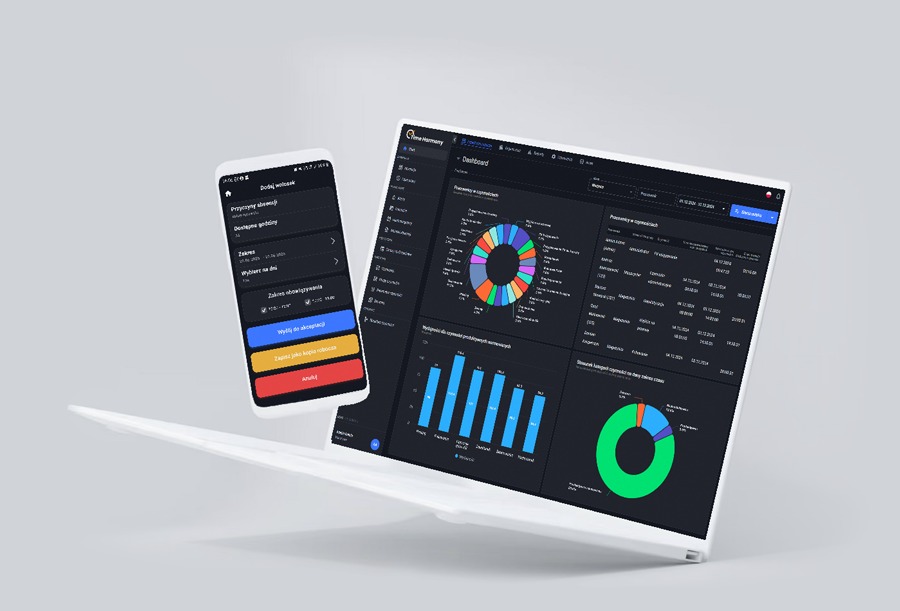
No software can substitute for a properly structured collaboration model — whether a contract is a sham comes down to how the work is actually carried out, not what system is running in the background. But since inspectors evaluate facts and expect documentation, a tool that records those facts systematically becomes a genuine asset if an inspection happens. This is where two Time Harmony modules come in:
Working time management (the T&A module) logs objective attendance data — clock-ins, clock-outs, breaks — in a form compliant with the Polish Labor Code, without forcing B2B contractors into the same rigid attendance rules as staff employees. That distinction matters: the system records facts, while the company retains control over how flexibly it structures contractor terms.
Activity measuring (the Activity and Productivity module) lets contractors log completed tasks — automatically via integrations with WMS/ERP systems, scanners and access gates, or manually for off-system activities. Together, this builds:
- A combined activity timeline merging T&A events, logged tasks and productivity data into one chronological view — a coherent record of what actually happened during the day, not just a raw hour count.
- Activity dashboards showing how many people were working on a given task, and for how long — data that's easy to cross-check against the terms of the contract.
- Output-based measurement, not process control — cumulative unit-completion tracking lets you settle work by outcome, which directly supports the "results, not dictated process" principle that matters most in a sham-contract assessment.
- A ready-made audit trail — a full history of activity and time records that can be exported quickly if an inspector requests documentation electronically during a remote inspection.
Data is hosted on EU-based servers with encryption and MFA authentication, in line with GDPR — relevant if personal data about contractors ever needs to be shared with a controlling authority.
In short: Working time management and Activity measuring don't make a collaboration model legally compliant on their own — but they generate the structured documentation that makes a genuinely compliant model much easier to defend.
A practical checklist before an inspection
Before PIP comes knocking, it's worth auditing your B2B contractor relationships against:
- Contract wording — do the clauses on location, hours and method of work leave the contractor genuine independence?
- Day-to-day practice — does how the collaboration is actually managed match what the contract says, or has it drifted?
- Communication and instructions — do managers issue operational orders to contractors the same way they would to staff employees?
- Documentation — can you reconstruct the history of the collaboration quickly: hours, tasks, deliverables?
- Contribution mix — does the ratio of B2B/mandate contracts to employment contracts in a given team look defensible given the nature of the work?
Running this audit now — not to sidestep the law, but to consciously formalise employment where the work genuinely functions as one — is far cheaper than doing it under the pressure of an active inspection.
Sham B2B contracts in Poland - summary
The 2026 reform doesn't redefine what counts as a sham B2B contract in Poland — that test has existed for decades. What changes is how effectively it's enforced: an administrative decision instead of a lengthy court case, higher fines, remote audits and data-driven targeting via ZUS and KAS. Under this regime, a company's safety depends less on what the contract says and more on whether it can demonstrate how the collaboration actually works. Systematic time and task records won't replace a properly structured collaboration model, but they provide the evidence that makes defending it significantly easier.
Related reading:
- 2026 Polish Labor Inspectorate reform (Reforma PIP 2026) in Logistics
- Recording working hours in Poland – legal requirements and employer obligations
- Legal source: Reform of the National Labor Inspectorate – gov.pl / Ministry of Family, Labor and Social Policy (Polish-language source)
Optimize working time and efficiency of your team