
Working time in August 2026 comes with one wrinkle that catches out even experienced HR teams managing Polish operations: 15 August, a statutory public holiday, falls on a Saturday this year. That's a materially different situation from a holiday falling on a Sunday or a weekday — and it changes both the total hours your team owes you and what you're required to do about it.
1. Working time in August 2026 – the short answer
Full-time: 160 hours, 20 working days. Half-time: 80 hours. Three-quarter time: 120 hours.
If that's all you needed, you have it. The rest of this article explains where the number comes from — and, more importantly, what you actually need to do in the schedule to hit it.
2. Where the number comes from
Under Article 130 §1–2 of the Polish Labour Code, working time for a settlement period is calculated as:
- 40 hours × the number of full weeks in the period,
- 8 hours for each remaining working day (Monday–Friday) outside those full weeks,
- 8 hours for each public holiday falling on a day other than Sunday.
For August 2026: 4 full weeks × 40 hours = 160 hours, plus one extra working day (Monday, 31 August) = 168 hours, minus 8 hours for the 15 August holiday = 160 hours.
Notice that in this calculation, 15 August is treated exactly the same as a holiday falling on a Tuesday or Wednesday — even though it's a Saturday. That's the detail that most often gets missed when a schedule is put together quickly.
3. Saturday is not Sunday – why it matters
This is the core of the whole topic, so it's worth spelling out clearly: a holiday falling on a Sunday changes nothing — Sunday is already a non-working day by law, so working time stays the same. That's what happened in May 2026, when 3 May fell on a Sunday.
A holiday falling on a Saturday works differently. Saturday isn't a statutory non-working day — it's only free because most employers operate an average five-day working week. Polish law therefore treats a Saturday holiday the same as a holiday on any working day: hours drop by 8, and the employer must additionally designate another day off within the same settlement period.
In other words, reducing the hour total is only half the obligation. The part most commonly forgotten is the second half: physically assigning employees a specific day as their "day in lieu" for the Saturday holiday.
4. Common scheduling mistakes in August
Three scenarios come up repeatedly in HR practice:
Forgetting the day off entirely. The schedule is built around 21 working days instead of 20, because someone accounted for the reduced hours but not the obligation to grant a specific day off. Result: employees end up working more hours than they should — and the Polish Labour Inspectorate treats this as a breach of the five-day working week rule, regardless of whether the total hours happen to balance out.
Splitting the day off into partial hours. Shortening several days by a couple of hours each instead of granting one full day off is not permitted — it breaks the rule on the number of non-working days, even if the hour total technically matches.
Pushing the day off into the following month. With a one-month settlement period, this is a straightforward compliance error — the day off for an August holiday must be used within August.
 The day off for a Saturday holiday must be granted before the end of the settlement period in which the holiday fell — not the calendar month. With a one-month settlement period the two coincide, so for August 2026 that means before the end of August. With longer periods (e.g. 3- or 6-month), the employer can pick any month within that period — what matters is the period's end date, not the calendar month.
5. Choosing the day off for 15 August
The choice of date is entirely up to the employer — you can decide unilaterally or agree it with staff, and you don't need to pick the same day for every department. In practice, two options work well:
- Friday, 14 August — gives employees a three-day weekend (14–16 August) and is usually the best-received option.
- Monday, 17 August — useful if you need coverage on the Friday (production, warehouse) and prefer to close the matter out right after the weekend.
Whichever you choose: communicate it with the same notice period you'd give for any other part of the work schedule (at least a week before the period it covers begins), and make sure the day falls within the current settlement period — see the next point for what that means if your settlement period is longer than one month.
6. Part-time staff and sick leave overlaps
For part-time employees, the rule is simple — multiply the full-time figure by the employment fraction: 160 hours × 1/2 = 80 hours, 160 hours × 3/4 = 120 hours.
A more nuanced case: what if the day designated as the "day in lieu" for 15 August falls during an employee's sick leave, maternity leave, or parental leave? If the employee had no scheduled work on that day anyway, the employer is not obliged to grant a replacement day once they return — the hour reduction only applies to hours that were actually scheduled to be worked. This comes up often in questions to the Polish Labour Inspectorate, so it's worth having the rule ready before someone asks.
7. How a T&A system takes this off your plate
None of the rules above are complicated on their own, but they need to be tracked every month, for every settlement period and every group of employees — which is exactly where mistakes creep in, especially across multiple locations or working time systems.
Time Harmony's working time calculation automatically settles working time in line with the current Polish Labour Code — including holidays that reduce working time, holidays falling on a Saturday, and the resulting day-off obligations within the correct settlement period. Instead of manually checking the calendar every time you adjust a schedule, it's calculated once, correctly, with no risk of a manual slip.
Want to see how this would work for your organization? Contact us — we'll walk you through how Time Harmony settles working time step by step.
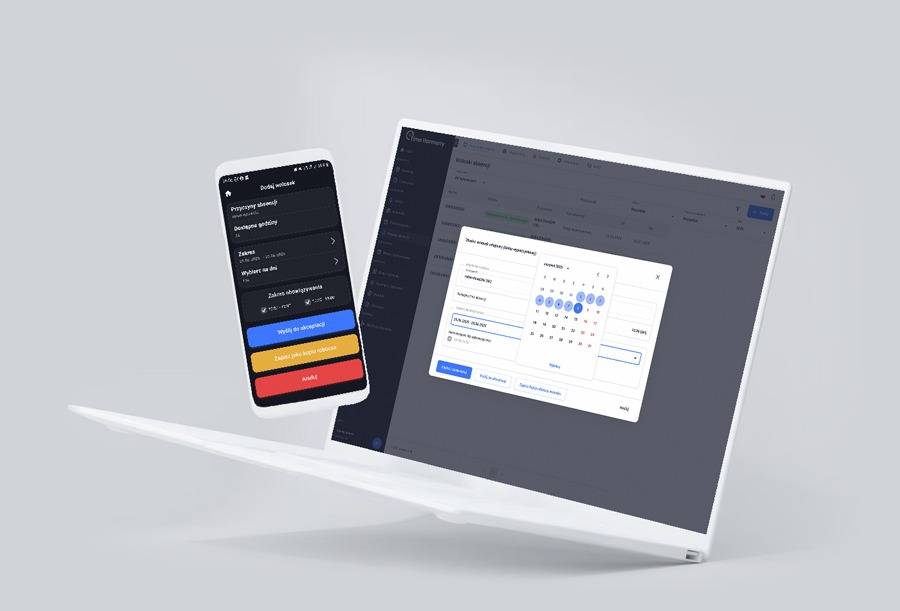
Easily manage your company's working time