
Occupational medical examinations in Poland are one of the areas most frequently checked by the Polish Labour Inspectorate (PIP) – and one of the easiest ways for an employer to unknowingly expose the company to a fine. Here's what the Polish Labour Code requires, who pays, what changes as of 17 April 2026, and how to make sure no deadline slips through.
1. What are occupational medical examinations in Poland and what types exist
The Polish Labour Code provides for three types of preventive occupational medical examinations:
- Preliminary examinations – mandatory for people being hired and for employees transferred to a position involving factors harmful to health or burdensome working conditions. Without a valid medical certificate, the employer cannot allow the person to start work.
- Periodic examinations – carried out on a recurring basis during employment. The Labour Code does not set one fixed frequency; the occupational medicine physician sets the next examination date in the certificate, based on the position and working conditions.
- Follow-up (control) examinations – mandatory for an employee returning to work after a sickness-related incapacity for work lasting longer than 30 days, to confirm fitness to continue in the current position.
2. How long are occupational medical certificates valid
The Labour Code does not set one fixed interval for periodic examinations – the occupational medicine physician determines the next examination date in each certificate, based on the position, harmful or burdensome factors, and the employee's health. In practice, the most common validity periods are:
- Preliminary examinations – typically valid from 1 to 5 years,
- Periodic examinations – most commonly 2 to 4 years, though for particularly demanding conditions (e.g. noise, chemical exposure, machine operation) the physician may shorten this to as little as 1 year,
- Follow-up examinations – the certificate remains valid until the date of the next periodic examination.
The date stated on the specific certificate is always decisive – the employer should refer the employee for the next examination before the previous certificate expires.
3. Legal basis – Article 229 of the Polish Labour Code
All three types of examinations are governed by Article 229 of the Labour Code. Key rules that follow from this provision:
- Examinations are carried out only on the basis of a referral issued by the employer, which must describe the working conditions at the given position, including harmful and burdensome factors.
- The employer may not allow an employee to work without a valid medical certificate confirming no contraindications to work at the specific position.
- Periodic and follow-up examinations are carried out, as far as possible, during working hours – the employee retains the right to remuneration for the time spent, and to reimbursement of travel costs if the examination takes place in another town, on the terms applicable to business trips.
- Employees rehired by the same employer for the same position or one with the same working conditions within 30 days of the previous contract's termination are exempt from preliminary examinations.
Employees, in turn, are obliged under Article 211(5) of the Labour Code to undergo the required medical examinations – refusal can be treated as a breach of basic employee duties.
4. Employer obligations: referral, costs, deadlines
In practice, the employer's obligation comes down to three elements:
- Issuing a referral – in two copies (one for the employee, one for the occupational medicine physician), describing the position and working conditions in detail.
- Sending employees for examinations on time – before allowing them to start work (preliminary examinations), before the previous certificate expires (periodic examinations), and after a long sickness absence (follow-up examinations).
- Keeping the documentation – referrals and medical certificates, in the employee's personal file.
In practice, the hardest part isn't knowing the rules – it's keeping track of expiry dates in real time, especially in companies with dozens or hundreds of employees across different positions and different examination schedules.
5. Who pays for the examinations
All costs of preventive medical examinations – preliminary, periodic, and follow-up – are borne entirely by the employer (Article 229 § 6 of the Labour Code). This also covers other costs of preventive healthcare necessary due to working conditions. Charging the employee for these costs, even temporarily – for example, with a promise of reimbursement after a probationary period – is not permitted.
6. Changes from 17 April 2026 – electronic medical certificates
On 2 April 2026, the Polish Ministry of Health published a regulation amending the rules for conducting occupational medical examinations and issuing medical certificates. As of 17 April 2026, occupational medical certificates are issued in electronic form. The change is part of a broader digitalisation of healthcare documentation carried out under Poland's National Recovery Plan.
For HR teams, this means a gradual shift away from paper certificates toward electronic documents – it's worth following official announcements from the Ministry of Health, as detailed implementation rules may still be refined.
7. Penalties for missing valid medical examinations
Allowing an employee to work without a valid medical certificate is an offence against employee rights related to failure to comply with occupational health and safety rules. Under Article 283 § 1 of the Labour Code, this carries a fine of PLN 1,000 to PLN 30,000.
In practice, during a Labour Inspectorate audit:
- a labour inspector may impose an on-the-spot fine of up to PLN 2,000,
- if the employer is fined a second time for an offence against employee rights within 2 years of the previous fine, the amount can reach up to PLN 5,000,
- higher amounts (up to PLN 30,000) are decided by a court in misdemeanour proceedings.
In addition, if a workplace accident occurs involving an employee without valid medical clearance, the employer faces increased civil liability and the risk that an insurer may reduce or refuse compensation.
8. Keeping track of deadlines with Time Harmony's electronic employee file
Tracking examination expiry dates manually in a spreadsheet works fine for a handful of employees – but with larger teams, position changes, and staff turnover, it becomes a real operational and legal risk.
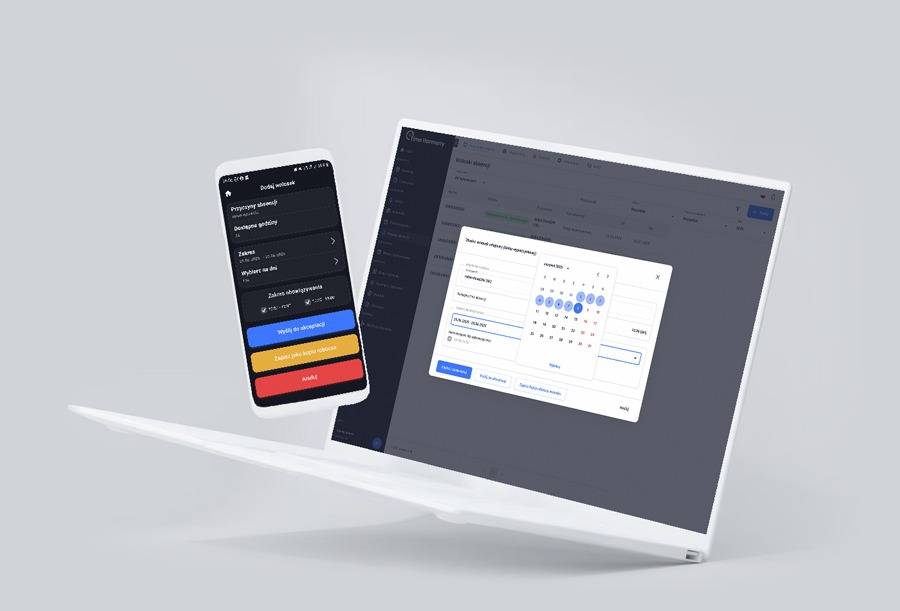
The Electronic Employee File module in Time Harmony lets you record preliminary, periodic, and on-the-job examinations in one place, alongside the rest of the employee's HR data. The system automatically reminds you of upcoming deadlines, reducing the risk of failing to meet the obligation under Article 229 of the Labour Code – and the employer liability that comes with it.
Easily manage your company's working time