
Recording working hours is not only a legal requirement, but also a key component of personnel management. Proper keeping of working time records allows for:
- correct calculation of salaries and allowances,
- maintaining transparency in the relationship between employer and employee,
- reducing the risk of litigation,
- better control over the efficiency of the organization.
Since July 8, 2026, this topic carries even more weight: the amended Act on the National Labour Inspectorate (Państwowa Inspekcja Pracy, PIP) gives inspectors broader enforcement powers, and fines for missing or unreliable records have risen significantly. A failure to keep proper working time records can now result in more serious financial consequences than it did a year ago.
📌Recording working hours ensures correct payroll settlements and legal security for the company — and since 2026, it also carries a notably higher financial risk in case of negligence.
1. Legal basis for recording working hours in 2026
Under Article 149 § 1 of the Polish Labour Code, every employer is obliged to keep working time records in a way that allows for the correct determination of remuneration and other work-related benefits.
The obligation to record working hours applies to every employee, regardless of:
- type of contract,
- system or working time schedule,
- full-time position.
Key change from July 8, 2026: Failing to keep such records constitutes an offence against employee rights (Article 281 § 1(6) of the Labour Code). Under the Act of March 11, 2026 amending the Act on the National Labour Inspectorate and certain other acts, the statutory fine range for this offence has doubled — from PLN 1,000–30,000 to PLN 2,000–60,000. The maximum on-the-spot fine an inspector can issue has also increased (from PLN 2,000 to PLN 5,000, and up to PLN 10,000 for repeat offences).
2. What working time records must include
Working time records for employees should cover, among other things:
- the number of hours worked, specifying the start and end times of work,
- overtime
- night work,
- on-call duty and the place where they are performed,
- non-working days with the basis for granting them,
- sick leave and other excused absences,
- unexcused absences.
For certain groups — such as employees under a task-based working time system, managerial staff, or those receiving a lump-sum allowance for overtime and night work — simplified records are permitted.
3. Symbols and codes used in working time records
In HR practice, it's common to mark individual entries in working time records with letter codes — this makes the documentation easier to read and speeds up its verification, for example during an inspection. Commonly used codes include:
| Code | Meaning |
| P | Work |
| UW | Annual (holiday) leave |
| UO | Occasional leave |
| UB | Unpaid leave |
| L4 | Sick leave |
| OP | Childcare leave (Art. 188 of the Labour Code) |
| NN | Unexcused absence |
| DL | Business trip |
| ND | Overtime |
It's worth noting that the law does not impose a single, mandatory set of codes — each company may use its own, as long as they are applied consistently across the organization. In an upcoming article, we'll publish a full, downloadable working time record template with a complete set of codes and guidance on how to use them.
3. Recording working hours for contractors
The obligation to document working time isn't limited to employees on a contract of employment. Under the rules on the minimum hourly rate (Act of October 10, 2002 on the minimum wage), the party ordering the work must also keep records of the hours worked under a contract of mandate or a contract for services. The way these hours are confirmed is agreed between the parties in the contract — it may be, for example, a written, electronic, or document-based confirmation.
This is particularly relevant in light of PIP's new powers to scrutinize civil-law contracts — an inspector can now check not only whether hours are documented at all, but also whether the actual nature of the cooperation shows the hallmarks of an employment relationship (based, among other things, on who actually supervises the work and whether specific working hours are imposed). We cover the criteria inspectors use for this assessment in detail in 2026 Polish Labor Inspectorate reform: What awaits logistics after July 8 and how to prepare — here, we simply want to flag that recording hours applies to contractors too, not only to employees.
4. Attendance list vs. working time records – the key difference
These are two different documents, often confused in practice:
- An attendance list merely confirms that an employee showed up for work (usually via signature or a card swipe) — it is not required by labour law and does not replace working time records.
- Working time records are the full documentation of start and end times, overtime, on-call duty, leave and absences — keeping them is a statutory obligation under Article 149 of the Labour Code.
Keeping only an attendance list, without full working time records, does not meet legal requirements and may expose the employer to liability.
5. How to prepare for a PIP inspection in 2026
Since July 8, 2026, PIP inspectors have broader inspection tools, and the stakes for gaps in working time documentation are higher than before. A few basics worth putting in place now:
- make sure working time records are kept for everyone engaged with the company, regardless of the form of cooperation,
- check that records are complete and kept up to date, not filled in retroactively,
- ensure codes and entries are clear and consistent across departments/locations,
- retain records for the required period (generally 10 years),
- where there is any doubt about the form of engagement, review civil-law contracts for features of an employment relationship.
6. Forms of recording working hours
The law does not impose a single form of documenting working hours. The employer may apply:
- paper records – traditional attendance lists,
- electronic records – modern RCP systems, applications and online tools.
More and more companies are choosing digital solutions that minimize the risk of errors and ensure compliance.
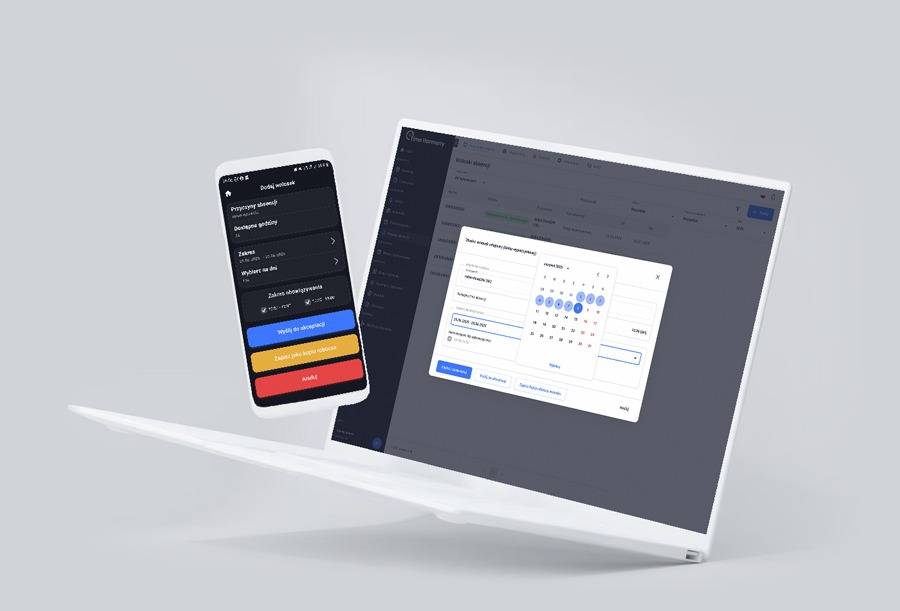
7. Recording Working Hours in Time Harmony
The Time Harmony system enables full, legally compliant recording of working hours in an electronic version. Thanks to it:
- employees can register entries and exits with an RFID card, PIN or QR code,
- it is possible to connect the system with turnstiles for full automation,
- people working remotely or in the office record their working time online,
- HR staff has access to current reports and analytics,
- data is securely stored in accordance with the current requirements of the Labour Code.
This reduces time-consuming administrative work, increases transparency across the company, and makes it easier to assemble complete documentation ahead of an inspection.
8. Summary
Recording working hours is a legal obligation for every employer under Polish labour law — and since July 8, 2026, with the amended PIP Act in force, the consequences of neglecting it are clearly harsher than before. Proper records are the basis for calculating pay, planning working time, and minimizing the risk of disputes and fines.
Implementing an electronic system such as Time Harmony not only helps meet legal requirements but also streamlines processes across the organization and keeps documentation inspection-ready.
Easily manage your company's working time