
Working time in Poland 2026 – rules, public holidays, and HR planning
Accurately determining the working time is essential for scheduling shifts and calculating employees’ hours. HR departments in 2026 in Poland must account for statutory public holidays and applicable settlement periods to ensure compliance with the Polish Labor Code.
Discover working time in Poland 2026, including statutory public holidays, calculation rules, and optimal leave planning. Learn how HR departments can efficiently manage monthly and quarterly schedules with minimal risk of overtime
Working time in Poland 2026 – legal basis
The obligation to establish working time is regulated by Article 130 of the Polish Labor Code, which applies to all organizations and employees regardless of position, working time system, or industry. The working time is always determined for a specific settlement period rather than as a fixed annual plan.
How to calculate working time in Poland 2026
Working time for a settlement period is calculated as follows: 40 hours multiplied by the number of full weeks, plus 8 hours for each additional working day outside full weeks, minus 8 hours for each statutory public holiday falling on a day other than Sunday.
Public holidays reducing working time in Poland 2026
Statutory public holidays reduce the total working time if they fall on days other than Sunday. In 2026, these days are:
- 1 January (Thursday) – New Year
- 6 January (Tuesday) – Epiphany
- 6 April (Monday) – Second day of Easter
- 1 May (Friday) – Labour Day
- 4 June (Thursday) – Corpus Christi
- 15 August (Saturday) – Assumption of Mary
- 11 November (Wednesday) – Independence Day
- 25 December (Friday) – Christmas Day
- 26 December (Saturday) – Second day of Christmas
Public holidays on Saturdays require the employer to grant an alternative day off within the settlement period, which also affects the total working time.
Working time in Poland 2026 – 1-month settlement period
For monthly settlement periods, working time is calculated separately for each calendar month. This approach ensures clarity and simplicity, especially in administrative and office departments.

Working time in Poland 2026 – 1-month settlement period
Working time in Poland 2026 – 3-month settlement period
Organizations using longer settlement periods calculate working time for the entire quarter. It is especially important to account for public holidays occurring during individual months.

Working time in Poland 2026 - 3 month settlement
Working time in Poland 2026 and leave planning
Although 2026 does not provide many opportunities for long, extended weekends in Poland, there are still a few periods to effectively extend time off:
- May holidays: Traditionally, this period allowed significant extension of leave, but in 2026, 1 May falls on Friday and 3 May on Sunday. Since holidays on Sunday do not require an additional day off, the 2026 May break offers only 3 days off.
- Corpus Christi – 4 June: Falling on Thursday, by taking leave on Friday 5 June, employees can enjoy a 4-day break.
- Assumption of Mary – 15 August: Normally suitable for an extended weekend, in 2026 it falls on Saturday. Although the employer must grant a substitute day off, this results in a maximum 3-day weekend if the day is given on the Friday or Monday adjacent to the weekend.
- November holidays: 1 November is a Sunday and does not provide an extra day off. Independence Day on 11 November falls on Wednesday; taking leave on 9–10 November creates a 5-day extended weekend.
Time Harmony as support for planning working time in Poland
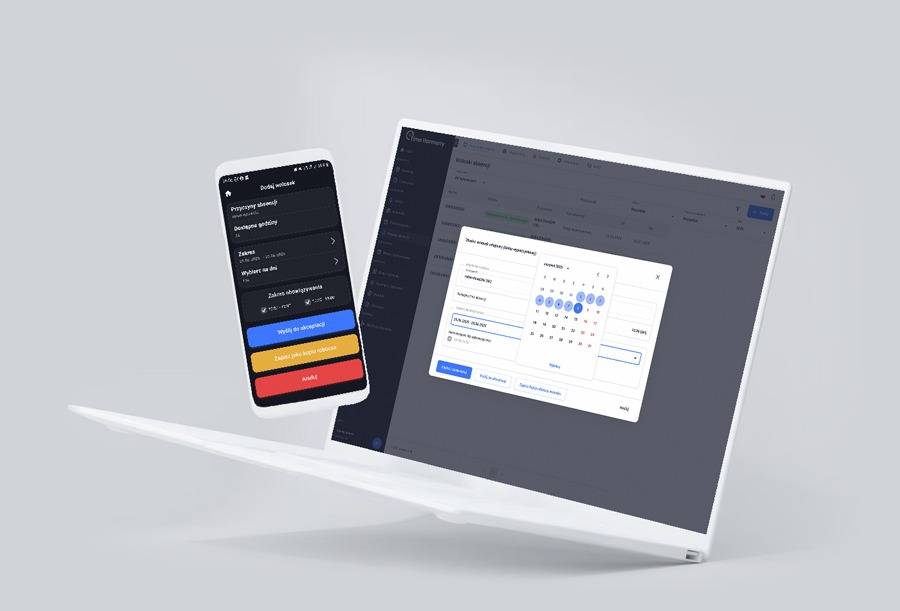
Time Harmony enables planning working time in compliance with the Polish Labor Code, taking into account different settlement periods within the same organization. The system allows HR departments to manage schedules for multiple departments while ensuring compliance with working time regulations.
Working time in Poland 2026 – summary
Working time in Poland 2026 is a key element in managing employee hours in any organization. Correct calculation forms the foundation for scheduling, leave planning, and compliance with the Polish Labor Code.
Easily manage your company's working time