
Labour law changes in Poland in 2026 will introduce one of the broadest regulatory updates in recent years. The reform covers the Labour Code, new duties for employers, expanded powers of the National Labour Inspectorate (PIP), as well as changes in employee documentation, seniority rules and payroll processes. For companies, this means the need to verify internal procedures, update HR and payroll systems, and prepare for a structural increase in employment costs.
Below is a comprehensive overview of the most important areas affected by labour law changes in Poland in 2026.
Minimum wage 2026 – increase in employment costs
From 1 January 2026, the minimum monthly wage will rise to PLN 4,806 gross, and the minimum hourly rate for civil-law contracts will reach PLN 31.40 gross. This change directly affects payroll budgets and will increase employment costs across all business sectors.
Key implications for employers include:
- higher ZUS contributions,
- the need to update remuneration regulations,
- review of all active contracts for compliance,
- early planning of pay increases to avoid budget shocks.
This regulatory increase will require organisations to revisit financial plans and payroll models for 2026–2027.
New rules for calculating seniority – expanded employee entitlements
One of the most impactful labour law changes in Poland in 2026 is the expansion of what counts toward employment seniority. From 2026, seniority will include professional activities that were previously excluded.
Seniority will now include:
- running a sole proprietorship,
- B2B cooperation,
- mandate and agency contracts,
- work performed abroad,
- periods covered by the “start-up relief”,
- membership in agricultural cooperatives.
Employment under a contract for specific work (umowa o dzieło) will not count toward seniority.
Implementation dates:
- public sector: from 1 January 2026,
- private sector: from 1 July 2026.
Implications for employers:
- longer holiday entitlement for many employees,
- extended notice periods,
- higher seniority-based benefits,
- the need to update HR and payroll systems,
- implementation of procedures for document verification (employees have 24 months to provide evidence).
Digital platforms such as Time Harmony, equipped with an employee records module, can support companies in gathering data, monitoring deadlines and building complete digital personnel files.
Digitalisation of employee documentation – end of the traditional “written form”
Labour law changes in Poland in 2026 introduce full equivalence between paper and electronic documentation. This affects key HR processes, including:
- monitoring notifications,
- consultations with trade unions,
- publication of working time schedules,
- applications for flexible forms of work,
- unpaid leave requests.
The main effects include faster document circulation and less administrative burden. However, employers must update internal policies and upgrade HR systems to ensure full compliance.
New rules for paying unused holiday compensation
Starting in 2026, the compensation for unused holiday leave must be paid on the next regular payday as defined in Article 85 of the Labour Code. If this date falls before the end of employment, employers will have 10 days after termination to finalise payment.
Benefits for employers:
- no need to generate additional payroll lists,
- more time to calculate final benefits accurately,
- simplified end-of-employment settlements.
New powers of the National Labour Inspectorate (PIP)
The draft bill significantly strengthens PIP’s authority. It introduces remote inspections and enables the Inspectorate to issue decisions reclassifying civil-law contracts as employment contracts.
Initially, the government proposed:
- immediate enforceability of such decisions,
- retroactive payment of taxes and ZUS contributions.
Following strong criticism from employer organisations, the Ministry of Labour withdrew the most contentious elements. The softened version removes:
- automatic enforceability,
- retroactive settlements of taxes and contributions.
The final draft was approved by the Standing Committee of the Council of Ministers on 4 December, and is scheduled for presentation on 15 December.
This reform will require employers to carefully analyse B2B relationships and civil-law contracts to reduce the risk of reclassification.
Gender pay gap reporting – obligation for large companies
From 2026, companies employing at least 250 people will become the first group covered by mandatory gender pay gap reporting, based on Directive 2023/970. The reporting scope includes:
- disclosing gender pay disparities,
- publishing pay structures.
In subsequent years, the obligation will extend to medium and smaller companies.
Implications for employers:
- implementation of transparent pay ranges,
- alignment of bonus systems,
- preparation of comparative pay analyses,
- mitigation of discrimination-related risks.
How companies should prepare for labour law changes in Poland in 2026
To ensure full compliance with labour law changes in Poland in 2026, organisations should:
- audit and update HR documentation,
- modify HR and payroll systems,
- review civil-law contracts and B2B partnerships,
- plan payroll budgets for 2026–2027,
- provide training for HR teams and managers.
Digital transformation, process organisation and continuous monitoring of employee activities will be crucial. Tools such as Time Harmony can significantly streamline preparation, reduce regulatory risk and support compliance with new obligations.
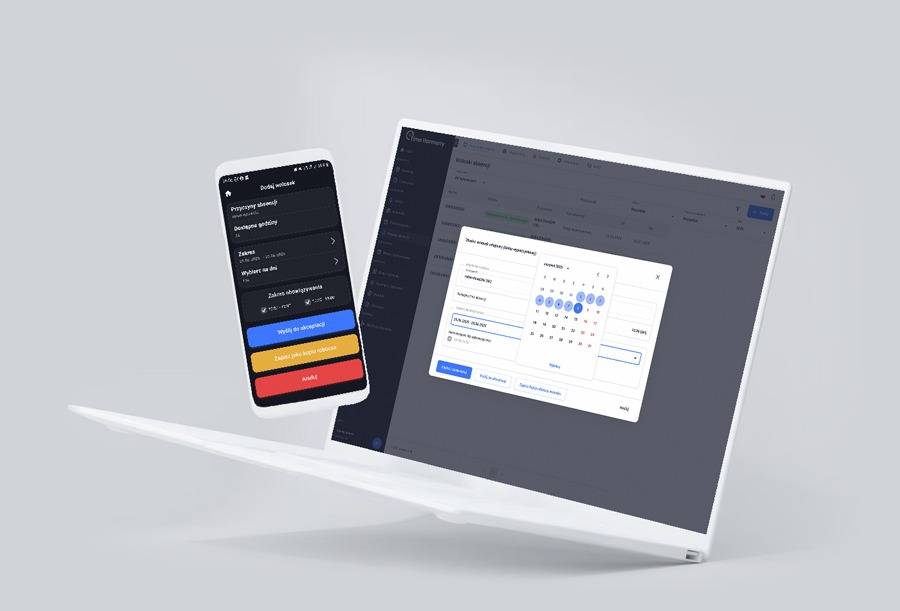
Easily manage your company's working time